
The Japanese Auction Sheet 'Decoder Ring': Fake Grade 4s, Rolled Odometers & Hidden Flood Damage
"If you cannot verify the chassis number against the original Japanese auction record, you are not buying a clean car—you are buying a KSh 200,000 lottery ticket."
Written by: Christopher Matere, Car Dealer Last Updated: January 2026 | Reading Time: 8 minutes | For: First-Time Kenyan Car Buyers, Salaried Professionals & Import Buyers
> In this guide: how to spot fake Grade 4 imports, rolled odometers, and hidden flood damage on a Japanese auction sheet.
Free Interactive Tool: Japanese Auction Sheet Self-Audit
Work through this with the actual sheet in front of you. It scores what you find — it does not look anything up.
Overall grade on the sheet
Mileage stars beside the odometer
★ is the mileage-doubt rating, not a panel mark. No star means accepted as accurate.
Chassis on the sheet matches the car
Compare the plate, the door jamb and the auction sheet. All three must agree.
W1 / W2 / W3 repair marks present
W = that panel was repaired. W1 minor, W2 visible, W3 major.
XX (panel replaced) anywhere on the diagram
…and any XX on a pillar, core support or floor
This is the distinction that matters. A front wing is bodywork; a B-pillar is not.
冠水 or 水没 in the inspector notes
Flood appears only in the handwritten notes, never in the damage grid.
骨格修正 (frame correction) in the notes
I have read the notes in translation
> 🛠️ Free Interactive Tool: Japanese Auction Sheet Self-Audit — with the actual sheet in front of you, work through the grade, the mileage stars, the W and XX marks and what the inspector notes say. It scores the sheet against the published grading rules. It does not look anything up: the major auction houses are members-only and publish no public API, so no free tool can pull a vehicle's auction history. What you can get is the original sheet and the lot number from your importer, who can verify it through their membership.
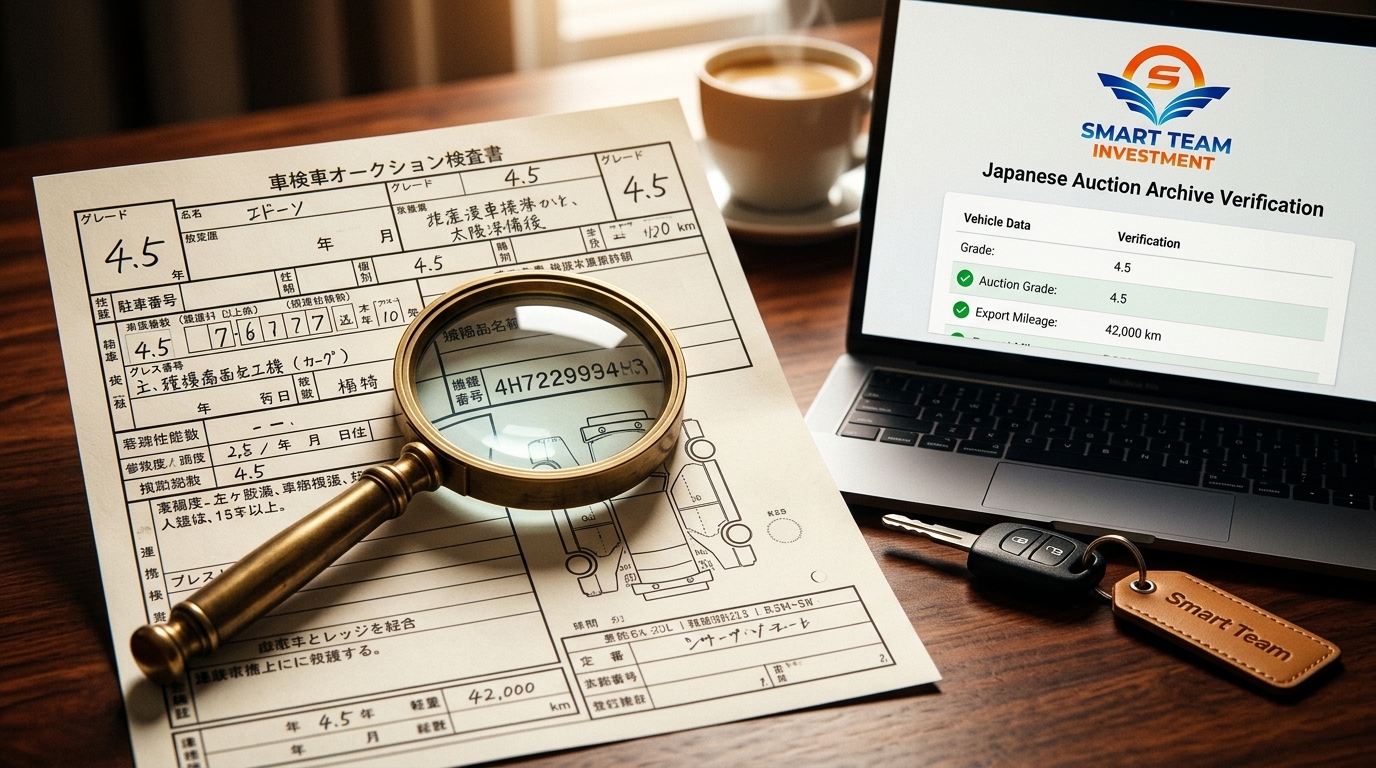
The 11:15 PM Facebook Scroll vs. The 87,000 km Reality
It is 11:15 PM on a Tuesday in Nairobi. You are lying in bed, scrolling through Facebook car groups and Jiji listings.
You find it: a sleek 2019 Toyota Axio or Nissan Note. Clean metallic paint, gleaming alloy wheels, and spotless seats. The dealer's caption reads: *"Fresh import, Grade 4.5, original low mileage 68,000 km, buy and drive, KSh 1.45 Million."*
You feel that rush—the excitement of finally owning a pristine Japanese import.
Stop right there.
Before you text the seller, before you draw down your SACCO savings, and before you pay a single shilling as a "holding deposit," you need to know a dirty secret of the Kenyan car trade:
More than 80 out of every 100 used cars on Kenyan roads were imported from Japan—and almost every single one passed through a neutral Japanese auction house (such as USS, TAA, CAA, JU, or HAA).
At that auction, a licensed, independent inspector examined every square inch of the car and documented its exact mechanical, cosmetic, and structural condition on a single document: The Japanese Auction Sheet.
> 📌 Related Car Buyer Guides in Kenya: > • Part 1: How Vehicle Valuation Caps Your Bank Loan Limit > • Part 2: Hire Purchase vs. Bank Loan: The KSh 165k Cash Trap > • Part 3: 7-Step Guide to Securing Car Asset Financing in Kenya > • Part 4: Top 5 Mechanical Checks for Used Cars on Kenyan Roads
Here is the uncomfortable truth: Most Kenyan buyers are shown cropped PDFs, photoshopped Grade 4.5 labels, or "clean" descriptions attached to R-Grade accident cars.
In one documented local investigation, a buyer was shown a "spotless Grade 4" Toyota Vitz showing 87,321 km on the dashboard. When checked against the original Japanese auction database, the real record revealed an R-Grade structural accident repair and an actual mileage of 143,299 km prior to export. The dealer had wiped 56,000 km off the odometer and concealed a buckled chassis beneath fresh paint!
This guide is your Decoder Ring. In the next 8 minutes, you will learn how to read every grade, damage code, and Japanese shorthand character so you can spot scams from a mile away and negotiate KSh 50,000 to KSh 200,000 off asking prices.
Rule #1 of the Auction Sheet: Trust the Paper, Not the Dealer
The inspector who inspects a vehicle in Tokyo, Nagoya, or Yokohama does not care who buys the car. They have zero incentive to lie. Their report records every scratch, dent, repaint trace, rust patch, and mechanical fault in precise Japanese shorthand.
The Golden Rule: *Nothing is real until you have the original auction sheet in your hand and the chassis number on it matches the car.* You cannot look this up online — the auction houses are members-only and publish no public API. Ask your exporter for the sheet and the lot number, which is what makes the record checkable.
If a dealer claims "showroom condition" but refuses to give you the uncropped auction sheet or chassis number, walk away immediately.
> Walk-away triggers and verification steps detailed in Top 5 Mechanical Checks for Used Cars on Kenyan Roads also apply here.
Overall Auction Grades: Decoding the Headline Score
In the top-right corner of the sheet sits the headline Grade. It combines body condition, mechanical state, and mileage into a single score ranging from 0.5 to 6, along with special characters:
| Grade | Meaning in Japan | Verdict for Kenyan Buyers |
|---|---|---|
| S / 6 | Brand new / Under 30,000 km. Near-flawless. | Premium price; rarely necessary for a daily driver. |
| 5 | Like new; under 50,000 km; microscopic flaws only. | Excellent condition—if your budget allows. |
| 4.5 | Light wear; usually under 100,000 km; tiny cosmetic marks. | Great value sweet spot for buyers. |
| 4 | Normal wear for age; minor scratches/small dents. | THE SAFE BASELINE—Buy with confidence. |
| 3.5 | Noticeable wear; visible dents/repairs needed. | Inspect closely; factor in KSh 80k–150k repair costs. |
| 3 | Heavy wear, deep scratches, rust, mechanical issues. | Budget-only; expect frequent garage visits. |
| 2 / 1 | Poor condition, severe neglect, or major modifications. | AVOID. |
| R / RA / 0 | Recorded Accident or Structural Repair History. | DANGER. Buy only with massive discount & independent chassis audit. |
| *** / 99 / x | Non-running, flood, fire, or major unrepaired impact. | ABSOLUTE NO. Walk away immediately. |
> ### 💡 The Golden Sweet Spot: Grade 4 > Grade 4 is the baseline every Kenyan buyer should demand. It represents a genuinely solid, reliable used vehicle with minor cosmetic imperfections at a fair market price. > * Why avoid Grade 3.5 or below? The "bargain" savings on the car yard will be wiped out the moment you spend KSh 100,000 replacing worn suspension bushings, repairing a slipping CVT transmission, or replacing corroded brake lines. > * Why watch out for Grade R? Grade R indicates the car suffered structural damage in Japan (chassis rail impact, pillar repair, floor pan deformation) and was repaired. A Grade R car may look pristine after fresh paint, but its resale value drops 30%–50%, and its structural safety in a crash is compromised.
*Internal: See Used Car Mechanical Inspection Kenya: 5 Critical Checks for how Grade R affects suspension/rust, and How Vehicle Valuation Affects Your Loan Limit for loan caps on R.*
Exterior & Interior Letter Ratings: The Two Letters Nobody Checks
To the right of the overall numeric grade sit two letter ratings—Exterior on the left (外) and Interior on the right (内). Both run from A (Pristine) to E (Very Poor):
- A: Pristine / Like new.
- B: Clean used condition; minor light scratches or light cabin wear.
- C: Visible scratches, small dents, stained upholstery, or carpet wear.
- D: Needs bodywork, torn seats, heavy stains, or foul odours (tobacco/pets).
- E: Very poor condition; requires complete interior restoration or major body overhaul.
How to Use Interior Scores as a Negotiation Tool
If you review an auction sheet marked as 4 / B / C, it means the vehicle has a solid Grade 4 overall rating and tidy exterior paint (B), but the interior has minor stains or seat wear (C).
Do not walk away! Use that "C" interior rating to demand a KSh 30,000 to KSh 50,000 price reduction on the yard, then spend KSh 10,000 on deep interior detailing at a reputable service center like Auto Express. You just saved KSh 20,000 to KSh 40,000!
> Negotiation lever also works for mechanical faults — see Used Car Mechanical Inspection Kenya: 5 Critical Checks walkaround checklist.
The Body Panel Diagram: Decoding Defect Codes
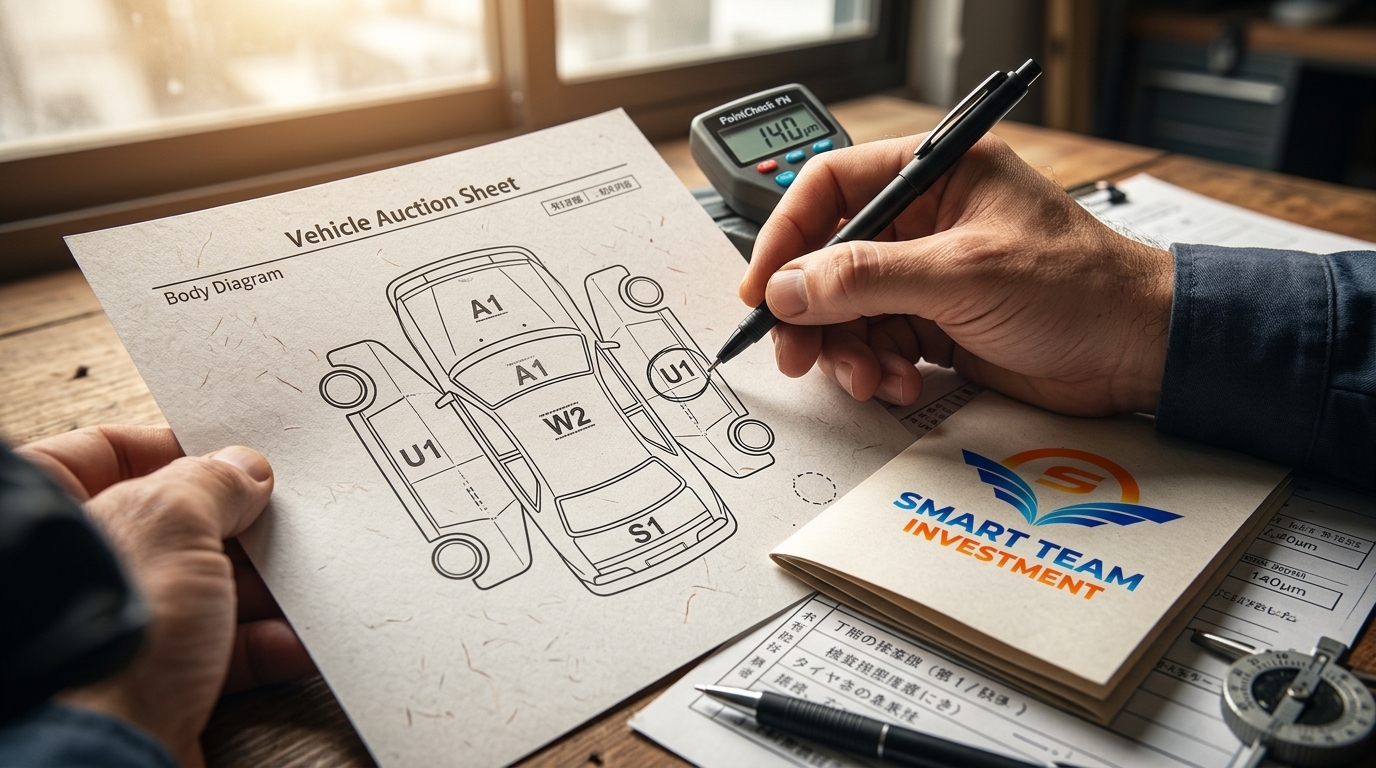
In the center of the auction sheet is a top-down diagram of the vehicle's body panels. Inspectors stamp letter-and-number codes on specific panels to indicate defects:
- The Letter = The type of defect.
- The Number (1 to 4) = Severity level (1 = minor/small, 4 = severe/large).
| Code | Defect Type | Meaning & Pocket Impact |
|---|---|---|
| A1–A4 | Scratch | A1 is a 2cm surface mark. A3/A4 is a deep gouge requiring respray. |
| U1–U4 | Dent | Panel dented, paint intact. U1/U2 can often be fixed via paintless dent repair. |
| B1–B4 | Dent with Scratch | Impact mark—requires panel beating and painting. |
| W1–W3 | Repair Wave / Repaint | CRITICAL: Evidence of past bodywork! W1 is subtle; W3 shows wavy filler work. |
| S1–S4 | Rust | Check location! S1 is light surface rust; S3/S4 on sills or wheel arches means structural rot. |
| C1–C4 | Corrosion | Worse than rust—metal is flaking or eaten through. Common on coastal/snow-region cars. |
| XX | Panel Replaced | Panel was unbolted and replaced. If clustered with W marks, suspect past collision. |
| Y / R | Crack / Glass Crack | Cracked plastic bumpers, light lenses, or windscreen stone chips. |
> ⚠️ THE "W3" REPAINT TRAP: > A car may look pristine under showroom lights on Ngong Road or in Mombasa, yet carry W3 marks across the bonnet and fenders on its auction sheet. W3 indicates heavy body filler and repainting. After 6 months under the hot Kenyan sun, cheap Japanese body filler can crack and peel.
Emergency Japanese Kanji: 5 Words That Mean "WALK AWAY"
Near the bottom of the sheet, the inspector writes notes in Japanese shorthand detailing vehicle usage and history. Memorise these 5 key Kanji terms:
| Japanese Kanji | English Translation | Buyer Action |
|---|---|---|
| 自家用 | Private Use | GREEN LIGHT — Standard private ownership history. |
| レンタ | Rental Vehicle | CAUTION — High-mileage, hard-driven car. Demand a discount. |
| 走行距離不明 | Odometer Unknown / Tampered | RED LIGHT — Mileage is unverified or clocked. Walk away. |
| 修復歴あり | Accident History / Structural Repair | RED LIGHT — Frame damage declared. Skip unless heavily discounted. |
| 水没 / 冠水 | FLOOD DAMAGE | DEATH SENTENCE — WALK AWAY IMMEDIATELY. |
Why 水没 (Flood Damage) Is a Complete Dealbreaker
Flood-damaged cars from Japanese typhoon zones are dried out, steam-cleaned, and exported quickly. On the surface, they look like Grade 4.5 gems.
However, within 3 to 6 months in Kenya, river-water silt corrodes the ECU wiring harness, ABS sensors, airbag modules, and transmission control units. You will be plagued by electrical glitches that mechanics in Industrial Area will struggle to diagnose. If you see 水没 or 冠水 anywhere on the inspector's notes, do not buy the car at any price!
> External authority: Verify flood/usage via QISJ Inspection Services and KEBS (opens in new tab).
The 4-Step "Scam-Proof" Verification Protocol
Before you hand over a single shilling for any "fresh import" in Kenya, execute this 4-step verification protocol:
``` [Step 1: Demand Uncropped Sheet] ➔ [Step 2: Chassis Verification] ➔ [Step 3: Engine Bay Sticker Match] ➔ [Step 4: Ground Inspection] ```
- Demand the Full, Uncropped Sheet: Do not accept screenshots or cropped printouts that hide the chassis number or inspector notes.
- Verify Against Original Auction Databases: Use a trusted verification service (such as JP Sheet or official auction archives) to pull the original auction record using the Chassis Number (e.g., NZE141-1234567). Check that the mileage, grade, and damage map match the paper in your hand.
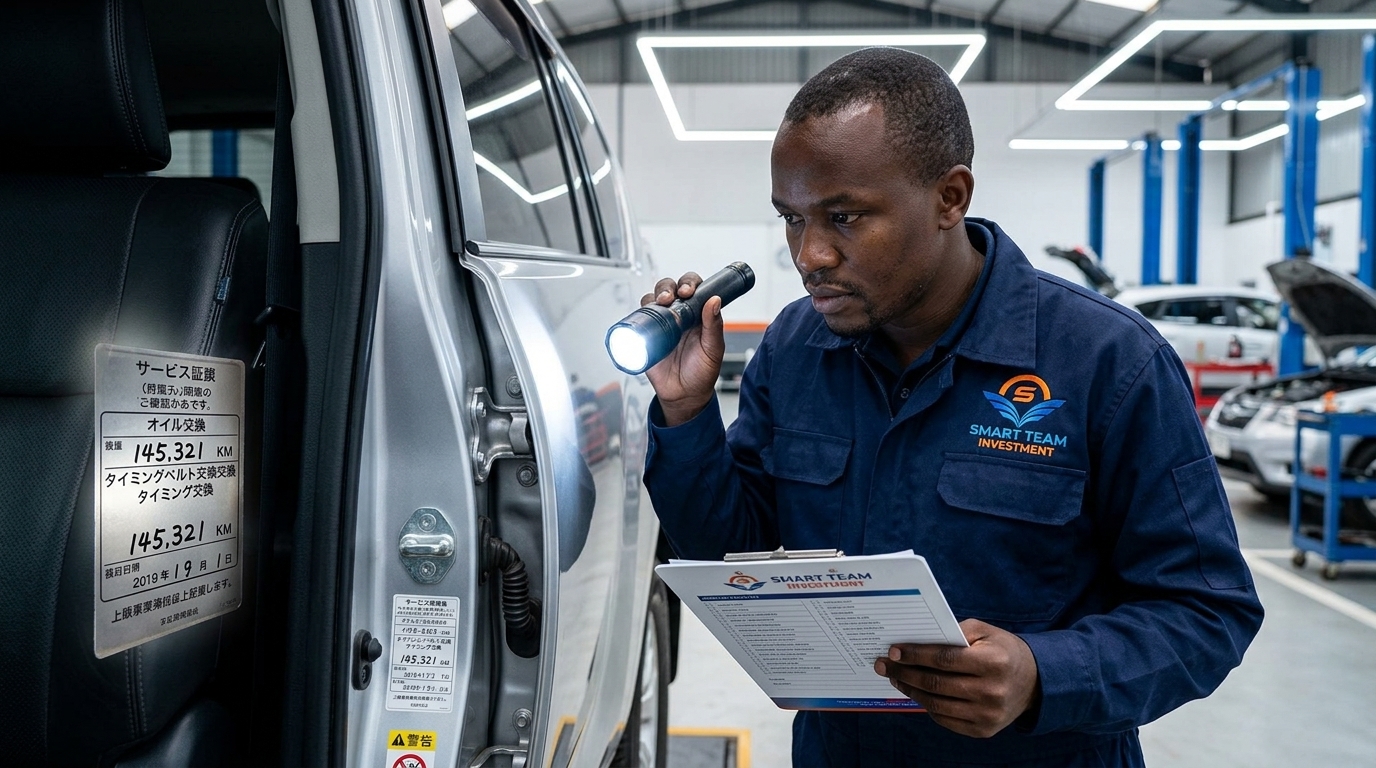
- Check the Engine Bay Odometer Sticker: In Japan, timing belts and oil services are logged on silver maintenance stickers inside the driver's door jamb or engine bay. If the dashboard reads 65,000 km but a Japanese service sticker reads 140,000 km (次回交換), you have caught a clocked odometer!
- Cross-Check Shipping & Port Damage: The auction sheet records condition *as it left Japan*. Inspect the car in person on the yard to ensure no port clearance damage or transit stripping occurred between Mombasa and Nairobi.
> 🔗 Official Kenyan Import & Regulatory Portals: > • Verify import compliance via KEBS (Kenya Bureau of Standards) (opens in new tab) > • Inspect vehicle roadworthiness requirements via QISJ Inspection Services (opens in new tab) > • Verify NTSA TIMS logbook details via NTSA TIMS Portal (opens in new tab)
> Related: How Custom Duty Is Calculated for Car Imports and Clearing Cars at Mombasa Port: Step by Step.
Summary Decision Matrix for Buying Japanese Imports
| What the Verified Sheet Says | Recommended Action |
|---|---|
| 4.5 / B / B | Buy with confidence (after independent mechanical check). |
| 4 / B / C | Baseline Buy — Negotiate KSh 30k–50k off for interior/cosmetic touch-ups. |
| 3.5 / C / D | Proceed only with price cut — Factor KSh 100k+ for suspension/service work. |
| 3 or below | WALK AWAY — High potential repair overhead. |
| Grade R / RA | DANGER — Require full structural chassis inspection & 30% price cut. |
| 水没 (Flood) / 走行距離不明 (Odo Unknown) | WALK AWAY IMMEDIATELY — Do not touch. |
| Dealer refuses chassis number / sheet | WALK AWAY — Unverified record. |
> Use this matrix together with the 10-minute walkaround in Used Car Mechanical Inspection Kenya: 5 Critical Checks.
Frequently Asked Questions (Voice & Long-Tail Intent)
Ask the seller for the chassis number plus the unconditional sheet and the lot number, and have it verified by an importer who holds auction membership. USS, JU and TAA are members-only and publish no public API, so there is no free website that can pull a real record. Third-party verification services resell licensed access for roughly $7–10 per vehicle. Beware "free" lookups: most return only confirmation that a chassis number exists somewhere, with no grade, mileage or damage map.
R records that repair history was declared, and it is not a condition score. R is significant, RA lighter, and R1/R2/RB/RC also appear. R is not only collisions: flood damage, fire-extinguisher damage and cars modified so illegally they could not be driven in Japan are also graded R. Read the inspector notes to see which you are looking at, and get a chassis inspection before buying structural work. It is not a KEBS bar — conformity is judged on the car's actual roadworthiness.
Yes. Digital odometers can be reprogrammed. The most reliable defense is to compare the current dashboard reading against the mileage logged on the original Japanese auction sheet and door jamb/engine bay service stickers.
Yes. Vehicles undergo pre-shipment roadworthiness inspection by QISJ on behalf of KEBS. However, QISJ inspects general mechanical safety, not cosmetic auction grade accuracy or post-arrival odometer changes.
Always confirm the current requirements on the official NTSA portal before you pay anyone, and keep the payment receipt.
THE GODFATHER OFFER: Get Your Auction Sheet Audited 100% FREE
Eyeing a "fresh import" on a car yard right now? Got an auction sheet from a dealer or clearing agent and want to know if it's real or photoshopped?
Do not gamble KSh 1.5 Million on trust.
For the next 48 hours, our team is offering a Free 1-on-1 WhatsApp Auction Sheet & Chassis Verification Audit (Valued at KES 15,000) for first-time Kenyan car buyers.
What We Will Do For You 100% Free:
- Original Auction Archive Lookup: We pull the original Japanese auction record using your car's chassis number to verify true mileage and grade.
- Japanese Kanji Translation: We translate every scribbled inspector note to catch hidden flood damage (水没), engine noise, or CVT slip notes.
- Damage Map Decoding: We decode every A, U, W, and S mark on the body diagram so you know exact repair costs before negotiating.
How to Claim Your Free Audit:
Simply take a photo or screenshot of the auction sheet (or send us the vehicle's Chassis Number) directly on WhatsApp:
👉 [CLICK HERE TO CLAIM YOUR FREE AUCTION SHEET AUDIT ON WHATSAPP (+254 790 406903)] (Or text "AUDIT" to +254 790 406903 / +254 700 000 000)

P.S. (TL;DR): A Japanese auction sheet is the most honest document in a car's life. It details every dent, repaint, and mechanical fault—written by neutral inspectors who don't care who buys the car. Never buy a car based on a dealer's word or a cropped PDF. Always verify the chassis number against original auction records. If you see 水没 (Flood) or W3 (Heavy Repair), run.
Explore more: How Vehicle Valuation Caps Your Bank Loan Limit • Hire Purchase vs. Bank Loan: The KSh 165k Cash Trap • 7-Step Guide to Securing Car Asset Financing in Kenya • Top 5 Mechanical Checks for Used Cars on Kenyan Roads
> Zero-Risk Guarantee: Send us your chassis number on WhatsApp right now. If we audit your sheet and prove it's clean, you buy with absolute peace of mind. If we catch a fake grade or clocked odometer, we just saved you KSh 1,500,000.
Japanese Auction Sheet Grades & Red Flags
Decode the grade, spot the doctored sheet, and know the difference between cosmetic damage and structural damage.
What you will discover inside
- ✓The grade scale explained, from S to R and what each means for value
- ✓Grade R / RA: what structural repair actually costs you
- ✓The auction sheet fields that are routinely edited or misread
- ✓Mileage cross-checks against service stickers and the current odometer
- ✓The specific figures that should make you walk away
Free Download: Japanese Auction Sheet Grades & Red Flags
100% free. Delivered instantly to your email and WhatsApp.