
Executive Summary & Market Reality
THE COLD TRUTH: 8 out of 10 cars driven off dealer lots in Nairobi and Mombasa are financed through bank asset loans rather than paid for in cash. Asset financing is no longer a luxury—it is the standard pathway for middle-class Kenyans to acquire personal and commercial vehicles.
However, despite thousands of monthly applications, over 60% of first-time applicants face humiliating rejections or 6-week processing delays. These rejections rarely stem from a lack of income; rather, applicants submit incomplete paperwork, present unorganized bank statements, or select vehicles that bank risk committees mark as non-financable.
``` [Step 0: Financial Prep] ➔ [Step 1: Vehicle & Invoice] ➔ [Step 2: Document Pack] ➔ [Step 3: Credit Analysis] ➔ [Step 4: Bank Valuation] ➔ [Step 5: Offer & Insurance] ➔ [Step 6: NTSA Lien & Keys] ```

Sound Familiar? The Nightmarish 11 PM Listing Trap
Imagine this scenario: It is 10:45 PM on a Tuesday. You have spent three weeks scrolling through car listings on Jiji and Facebook Marketplace. You finally spot the one—a clean, silver Toyota Premio or Nissan Note listed at KSh 1.4 million at a Ngong Road dealership.
Your heart races. You have saved KSh 350,000 for a deposit, and your gross monthly salary of KSh 120,000 comfortably covers monthly repayments. You call the dealer, pay a KSh 20,000 "holding fee," and walk proudly into your bank's Asset Finance department expecting a quick approval.
Then the reality check hits like a bucket of cold water:
- "Application Declined (CRB Flag):" A forgotten KSh 2,500 Fuliza balance or an old mobile loan default from 2022 flagged your credit profile at Metropol or TransUnion.
- "Income Discrepancy:" Your payslip reflects KSh 120,000 gross, but your bank statements show cash withdrawals and irregular M-Pesa sweeps that concern credit analysts.
- "Vehicle Rejected:" The bank refuses to finance a 2014 model or an exotic grey import because their risk committee classifies it as a "low liquid resale asset."
- The 6-Week Limbo: Your file collects dust on a loan officer's desk because you missed a single "Employer Comfort Letter."
Meanwhile, the dealership sells your target car to a cash buyer, forfeits your holding fee, and leaves you commuting by matatu in the rain.

The Secret: Banks Follow a Strict 4-Point Credit Code
Credit analysts in Kenyan commercial banks do not make lending decisions based on emotion or vehicle paint quality. They evaluate every asset finance file against an exact 4-point risk grid:
- Repayment Capacity (Affordability): Your total monthly car loan instalment must fit comfortably within 25% to 33% of your net take-home pay.
- Identity & Employment Stability: You must prove steady employment or verifiable business cash flow for a minimum of 6 to 12 months.
- Credit Bureau History: Your Metropol CRB or TransUnion credit report must be 100% clear of active defaults.
- Collateral Quality: The vehicle must be under 8 years old, manufactured by a high-liquidity brand (Toyota, Honda, Mazda, Nissan), and valued by an approved bank valuer.
| Risk Check | What Analyst Looks For | Red Flag |
|---|---|---|
| Repayment Capacity | Instalment ≤33% net pay | >40% or existing SACCO drain |
| Identity & Stability | 6–12 months salary trail, employer letter | Cash withdrawals, M-Pesa sweeps |
| CRB History | 100% green Metropol/TransUnion | Any Fuliza/Hustler default |
| Collateral Quality | <8 years, Toyota/Honda/Mazda/Nissan, OMV valuer | >8 years, exotic grey import |
*See how OMV caps your loan: Vehicle Valuation and Loan Limits in Kenya.*
Step 0: Prepare Your Financials Before Visiting a Car Yard
The single biggest mistake first-time buyers make is picking a car first and seeking financing second. Reverse the order.
- Build a 3-to-6 Month Banking Trail: Commercial lenders favor existing account holders. If your monthly salary deposits into Bank A, submit your application to Bank A first. Avoid draining your account to zero within hours of payday, as low average daily balances signal financial instability.
- Run a Pre-Application CRB Audit: Request your credit report from TransUnion Kenya or Metropol before applying. Resolve any outstanding Fuliza, Hustler Fund, or mobile app balances. Even a KSh 500 mobile loan listing can freeze a KSh 1.5M asset finance application.
- Calculate Your True "Debt Envelope": Ensure total monthly debt deductions (including SACCO loans, personal loans, and payroll check-offs) do not exceed 50% of your net pay. Your vehicle instalment specifically should remain under 30% of net pay.
> Pro Tip from Part 2: Compare loan vs hire before you commit — Hire Purchase vs Bank Loans in Kenya shows the KSh 165k flat-rate trap.
Step 1: Select a "Bank-Friendly" Vehicle & Obtain a Proforma Invoice
Banks do not finance unstructured vehicle listings—they finance a specific chassis and engine number documented on an official Proforma Invoice or Sale Agreement from a registered dealership.
| Vehicle Parameter | Bank Approval Sweet Spot | High-Risk Zone (Hard / Expensive to Finance) |
|---|---|---|
| Vehicle Age | Manufactured within 8 years (e.g., 2019–2026 models) | Older than 8 years (Requires high-interest microfinanciers) |
| Make & Model | High resale liquidity: Toyota (Axio, Fielder, Premio), Honda (Fit, Vezel), Mazda (CX-5, Demio) | Rare European models (BMW, Mercedes, Audi) or low-demand grey imports |
| Dealership Status | KRA-compliant dealership on Ngong Rd, Kiambu Rd, or Mombasa Rd | Private individual sellers (Requires complex private sale agreements) |
Pro Tip: Negotiate the purchase price with the dealer while remembering that the bank's independent valuer—not the dealer's sticker price—determines your maximum loan threshold.
> *For a detailed analysis of how vehicle valuation reports dictate loan ceilings, read our guide on Vehicle Valuation Loan Limits in Kenya.*
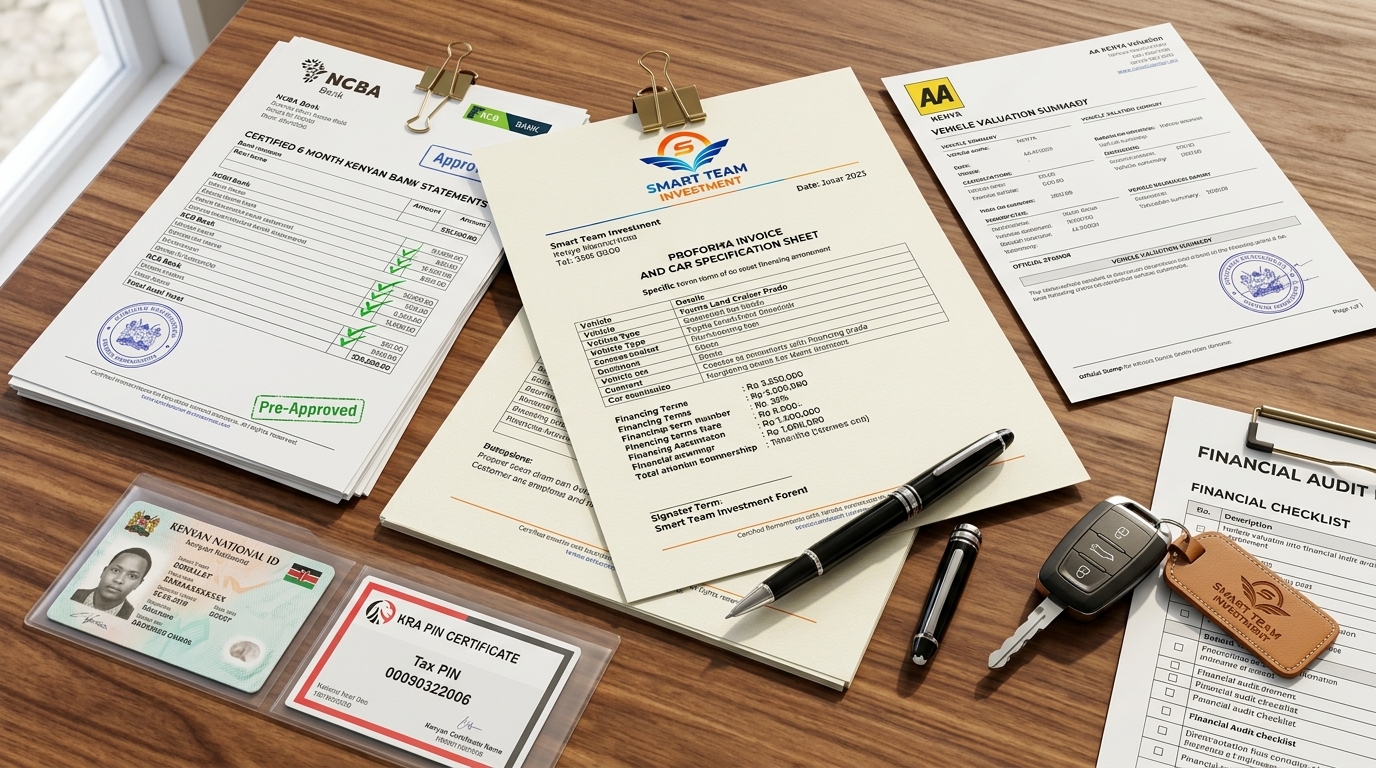
Step 2: Assemble the Non-Negotiable 8-Document Pack
Incomplete documentation accounts for 80% of loan processing delays in Kenyan banks. Assemble these eight items in a dedicated application folder:
- Completed Bank Asset Finance Application Form (Signed and dated).
- Copy of National ID & KRA PIN Certificate.
- Latest 3 Months' Certified Payslips (Stamped by your employer's HR department).
- Employer Comfort / Introduction Letter (Confirming permanent employment status).
- Latest 6 Months' Certified Bank Statements (Stamped on every page by your bank).
- Dealer Proforma Invoice (Detailing chassis number, engine capacity, color, purchase price, and bank payment details).
- Copy of Vehicle Logbook or Importation Documents (CRSP clearance, QISJ certificate, and Import Entry for fresh imports).
- Copy of Dealer's KRA PIN & Certificate of Incorporation.
(Self-Employed Applicants: Replace payslips with Business Registration / CR12 form, 12 months' audited financial accounts, and current county business permits).
*Checklist tip: Scan all 8 into one PDF, name it SURNAME_ASSET_2026.pdf — credit analysts love tidy files. See How to Avoid Logbook Scams in Kenya for document verification.*
Step 3: Understand the Credit Analyst's Hidden Calculation
Once submitted, your file undergoes mathematical evaluation by a credit risk analyst. Lenders apply a standardized affordability equation:
Maximum Allowed Monthly Instalment = (Net Take-Home Pay - Existing Monthly Debt) × 0.33
Worked Example: Salaried Buyer ("Brian")
- Gross Monthly Salary: KSh 120,000
- Net Monthly Take-Home Pay: KSh 88,000
- Existing SACCO Loan Deduction: KSh 12,000/month
- Available Net Income: KSh 76,000
- Maximum Monthly Car Payment Allowed: KSh 76,000 × 0.33 = KSh 25,080/month
If financing a KSh 1.4M car over 48 months requires an instalment of KSh 32,000/month, the bank will not reject you outright. Instead, they will request a higher cash down payment (deposit) to reduce the principal loan amount until the monthly payment matches KSh 25,080.
Car Asset Financing Monthly Payment Calculator
Calculate your monthly payment, required deposit, and bank eligibility in Kenya
Max Allowed (33% rule)
KSh 25,080/mo
Net KSh 88,000 − Debt KSh 12,000 × 33%
Your Loan Payment
KSh 32,550/mo
Principal KSh 1,120,000 • Interest KSh 442,395 • Total KSh 1,562,395
Bank Verdict
✗ Over by KSh 7,470/mo
Add KSh 257,029 extra deposit or extend tenure.
Deposit KSh 280,000 (20%) • Financed KSh 1,120,000 • Rate 17.4% red. • Check valuation limits vs hire purchase
*Try Brian’s numbers in the calculator above — toggle deposit 10/20/30% and see the verdict flip from red to green. For hire vs loan comparison, see Hire Purchase vs Bank Loans in Kenya.*
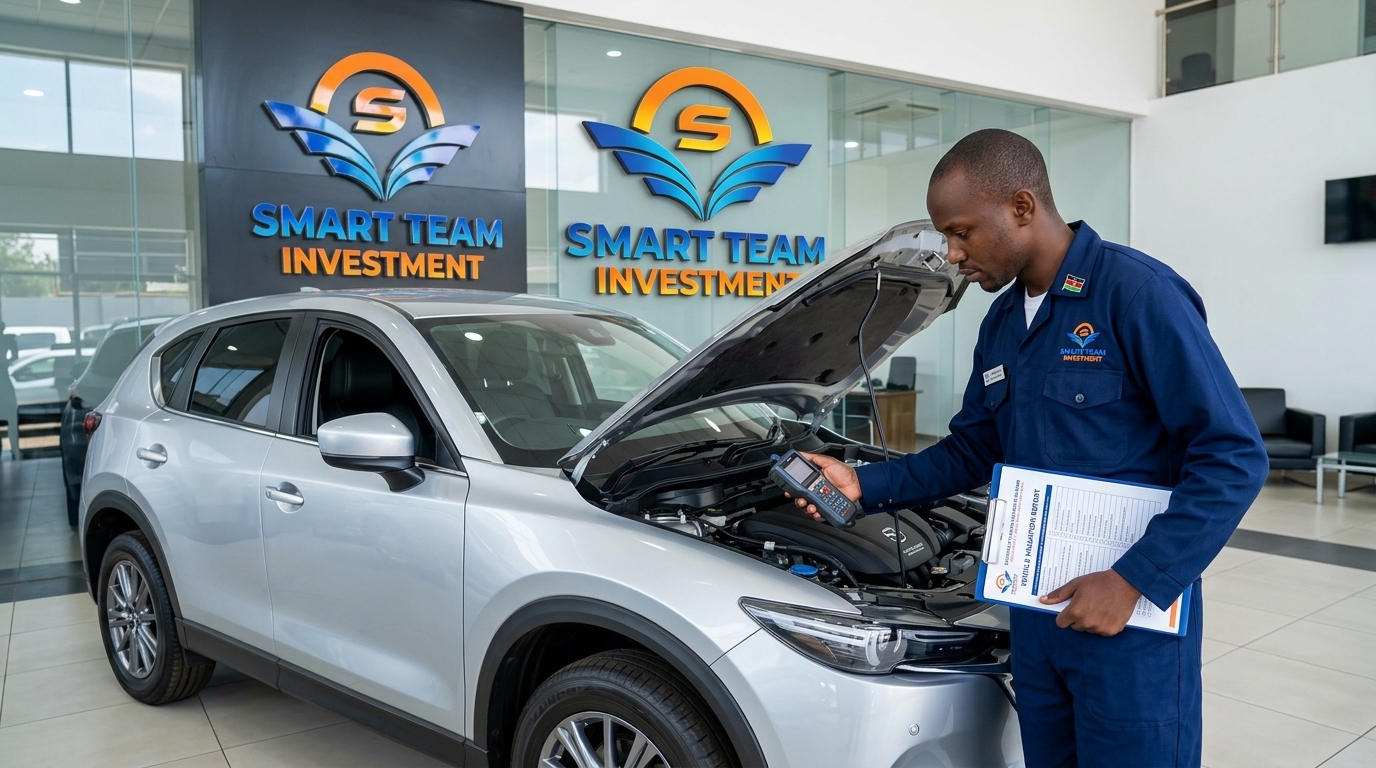
Step 4: Complete the Official Bank Valuation
Upon preliminary credit approval, the bank issues a valuation letter appointing an independent valuer from their approved panel—such as AA Kenya, Regent Auto Valuers, or Avenue Valuers. See approved valuers at AA Kenya (opens in new tab).
- Valuation Fee: KSh 3,000 – KSh 5,000 (Paid by the applicant).
- Turnaround Time: 24 to 48 hours.
The Loan Ceiling Formula:
Maximum Bank Loan Amount = Valuer's Open Market Value (OMV) × Bank LTV %
Negotiation Strategy: If the bank's valuer values the vehicle at KSh 1.2 million but the dealer requested KSh 1.3 million, do not pay the KSh 100,000 difference out of pocket. Present the official valuation report to the dealer to negotiate the price down. Dealerships rarely forfeit financed transactions and will typically adjust their price to match the OMV report.
Step 5: Review the Letter of Offer, Deposit & Insurance
Once the valuation is approved, the bank issues a formal Letter of Offer.
- Review Key Financial Terms: Inspect the interest rate (typically 13%–18% reducing balance; average commercial rate is ~17.4% APR), loan tenure (24–48 months), processing fees (1%–2%), and early settlement clauses.
- Deposit Payment: Pay your 10%–20% cash deposit directly to the dealership (or into the bank's designated escrow account as outlined in your offer letter).
- Comprehensive Insurance Placement: The vehicle must be comprehensively insured with the bank designated as the First Loss Payee. Most lenders allow you to spread annual insurance costs into monthly loan instalments through Insurance Premium Financing (IPF).
> *Not sure whether bank asset financing or hire purchase is better suited for your budget? Compare both structures in our breakdown: Hire Purchase vs Bank Loans in Kenya.*
*External reference: Verify NTSA charges on NTSA Portal before paying.*
Step 6: Loan Disbursement & NTSA Joint Registration
- Direct Disbursement: The bank transfers funds directly to the dealership via RTGS or Banker's Cheque. Funds are never disbursed into personal transaction accounts.
- NTSA TIMS / Citizen Joint Registration: Vehicle ownership is updated on the NTSA TIMS Portal (opens in new tab) to reflect Joint Ownership between you and the lender (e.g., "Brian / Stanbic Bank Kenya Ltd").
- Vehicle Handover: Following GPS tracking unit installation by an approved vendor, you receive your keys and drive off the lot while monthly check-offs or standing orders commence.

*For logbook update steps, see NTSA eCitizen Logbook Transfer Guide.*
If the Bank Says No: The Alternative Financing Hierarchy
If you fall outside strict commercial bank criteria (e.g., lack of traditional payslips or minor credit flags), alternative financing models exist across Kenya:
``` [Level 1: SASRA SACCOs] ➔ [Level 2: Islamic Banks] ➔ [Level 3: Dealer Schemes] ➔ [Level 4: Microfinanciers] ```
| Financing Channel | Processing Time | Ideal Applicant Profile | Loan Terms & LTV Thresholds | Cost Structure |
|---|---|---|---|---|
| SASRA SACCOs (Stima, Harambee, Police) | 1 – 2 Weeks | Active SACCO members (6+ months history) | Borrow 3x–4x savings deposits at 10%–12% interest | Lowest Cost (Best Overall Value) |
| Islamic Asset Finance (Gulf African, NCBA Loop) | 3 – 7 Days | Ethical / Shari'ah-compliant buyers | Murabaha cost-plus profit rate structure | Competitive Commercial Rates |
| Dealer Partner Schemes | 2 – 5 Days | Buyers purchasing specific dealership inventory | Pre-negotiated bank partnerships (Up to 100% LTV) | Standard Commercial Rates |
| Microfinanciers (MOGO, Aspire, FinAccess) | 24 – 48 Hours | Informal income / CRB issues | Financed via M-Pesa statements (20% deposit) | High Cost ("Convenience Premium") |
*For cost comparison with flat-rate HP, see Hire Purchase vs Bank Loans in Kenya.*
Frequently Asked Questions (FAQs)
Yes. Commercial banks and microfinanciers finance self-employed individuals and business owners in Kenya. Applicants must provide a Business Registration Certificate or CR12, 12 months of stamped business bank statements, audited financial accounts, and valid business permits.
Most commercial banks in Kenya finance vehicles manufactured within the last 8 years. For instance, in 2026, the oldest vehicle eligible for bank asset financing is typically a 2018 or 2019 model.
If you default on instalments, the lender issues demand notices. Continued non-payment results in repossession by licensed auctioneers and sale of the vehicle at Forced Sale Value (FSV) to recover outstanding debt.
Yes, most Kenyan banks allow early settlement. However, review your Letter of Offer as some institutions charge an early redemption fee of 1% to 2% on the remaining principal balance.
Always confirm the current requirements on the official NTSA portal before you pay anyone, and keep the payment receipt.
What To Do Next: Claim Your Free Pre-Application Audit
Submitting applications to multiple banks simultaneously damages your credit rating and increases the risk of rejection. Verify your borrowing status before signing paperwork.
The "Zero-Surprise" Pre-Application Audit Offer
We offer a Free 1-on-1 Pre-Application Loan & Document Audit for salaried professionals and business owners in Kenya:
- CRB & Affordability Check: We calculate your exact borrowing threshold using official bank affordability formulas.
- Document Audit: We review your payslips, bank statements, and employer letters to eliminate the top 5 rejection causes.
- Lender & Vehicle Matching: We match your target car against approved lender panels (Stanbic, NCBA, I&M, Absa, and SACCOs) to secure maximum LTV financing.
📲 Claim Your Free Audit on WhatsApp: Send "LOAN AUDIT" or your proforma invoice to +254 790 406903.
Summary Checklist (TL;DR)
- Pre-Approve First: Obtain credit pre-approval and verify your CRB status before selecting a car.
- Select 8-Year-Old Models: Toyotas, Hondas, and Mazdas under 8 years old qualify for 80%–90% bank financing quickly.
- Keep Instalments Under 33%: Ensure monthly payments do not exceed one-third of your net income.
- Use Valuation for Leverage: Utilize the bank valuer's Open Market Value (OMV) report to negotiate dealer discounts.
- Keep Paperwork Organized: Organize all 8 required documents upfront to avoid processing delays.
Explore more: Vehicle Valuation and Loan Limits in Kenya • Hire Purchase vs Bank Loans in Kenya • How Custom Duty Is Calculated for Car Imports • NTSA eCitizen Logbook Transfer Guide.
The Car Asset Financing Approval Checklist
What banks actually assess on your file, and how to assemble it so approval is a formality.
What you will discover inside
- ✓The document set a lender expects from a salaried applicant
- ✓The document set for a self-employed applicant (CR12, stamped statements, permits)
- ✓The maximum vehicle age most lenders will finance
- ✓How the valuation, the deposit, and the LTV interact
- ✓What happens at repossession, and the early-settlement terms to read for
Free Download: The Car Asset Financing Approval Checklist
100% free. Delivered instantly to your email and WhatsApp.