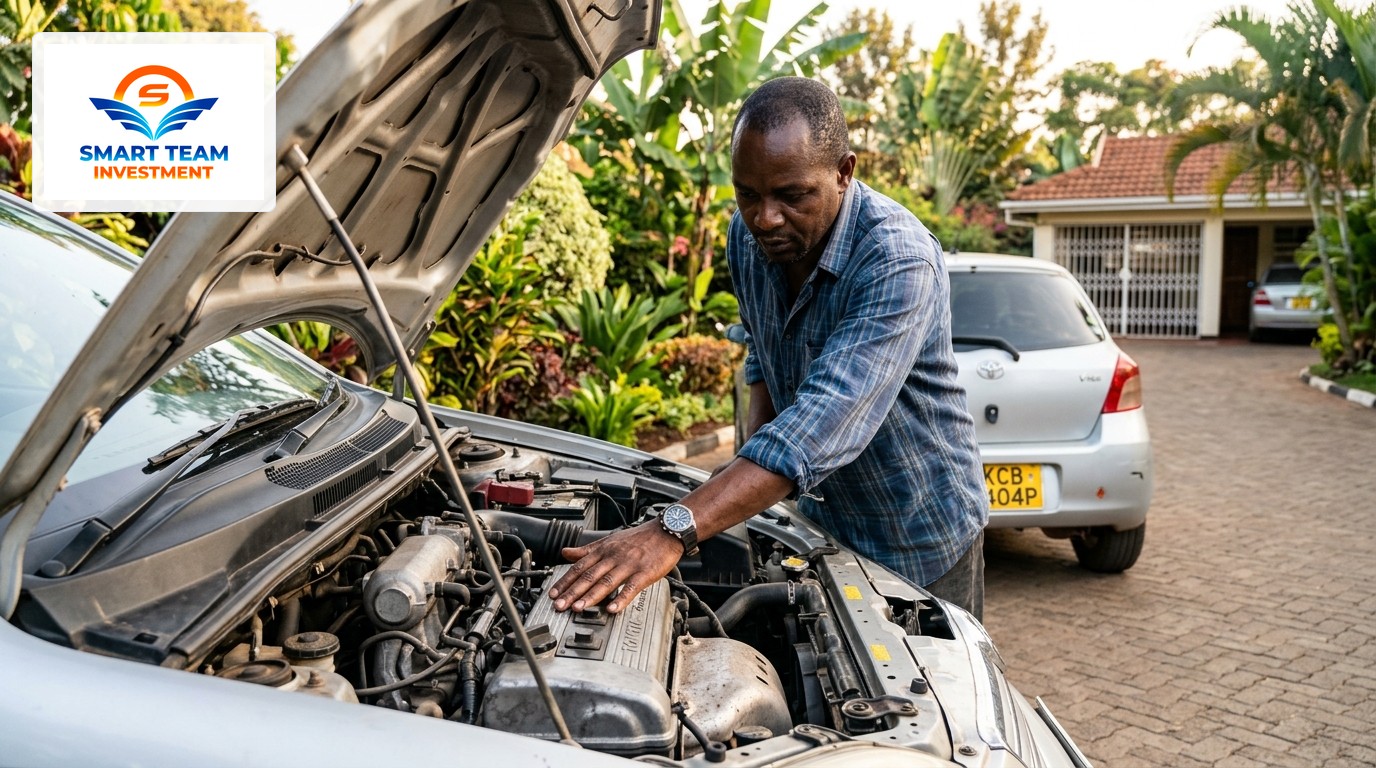
The Test Drive Starts Cold: what should I check before the engine turns over?
The first two minutes of a cold start tell you more than the next twenty. A specialist's diagnostic guidance states that overheating protection mode appears "after sustained driving, hills, towing or hot weather", and that the vehicle's hot-versus-cold behaviour should be recorded alongside road speed, engine RPM, load and grade [EVI-067]. That is the whole test in one line: record what the car does cold, then record what it does hot, and compare.
Three things must happen before you turn the key:
1. Ask for a cold engine. Say it plainly when you confirm the appointment: "please do not start the car before I arrive." If the car is already at operating temperature when you walk up, note it. A seller who warms the car has removed the evidence you came for. 2. Listen for the engagement delay. Put it in drive, then reverse, from a stop. Count how long the car takes to bite. A clean Vitz engages almost immediately. Hesitation is the classic CVT tell [EVI-067]. 3. Check the fluid record, not just the fluid. A Kenyan review puts Vitz CVT fluid at roughly every 40,000 km, and notes that later transmission problems follow skipped changes [EVI-068]. Ask for the invoice. And remember that "CVT fluid" is not one interchangeable product — it is application-specific, so a vague "we used automatic gearbox oil" is not an answer [EVI-067].
| Cold check | What a healthy Vitz does | What a warning looks like | Evidence |
|---|---|---|---|
| Drive engagement from stop | Immediate bite | Noticeable delay or jerk | [EVI-067] |
| Reverse engagement | Immediate bite | Delayed or shuddering | [EVI-067] |
| Cold idle | Steady, quiet | Rattle or hunting revs | [EVI-019] |
| First-minute whine | None | Whine or bearing noise | [EVI-067] |
| Fluid record | Dated invoices | "It was changed" with no paper | [EVI-068] |
Why the route matters more than the mileage
A flat lap cannot find the Vitz's real fault. Overheating protection mode shows up "after sustained driving, hills, towing or hot weather" [EVI-067]. A five-minute spin around the block will not produce it. So build the route deliberately: a sustained climb, a stretch of steady cruising, then a stop-and-go return, and only then park and shut off.
While you are driving, the thing to listen for is not engine noise — it is the transmission changing its mind. On the older 2013 generation, Topcar's review is blunt that "the CVT gearbox is sensitive to bad quality transmission fluid and failures have been reported" [EVI-069]. That sensitivity is what you are hunting: a ratio that flares, hunts or refuses to hold on the climb is the gearbox telling you what the seller will not.
Also worth knowing before you shop: the 1.0L is not slow because it is small, it is slow because it is a 1.0L. Topcar's measured figures for the older generation run 15.3 seconds to 100 km/h for the 1.0L, against 11.7 for the 1.3L and 9.5 for the 1.5L [EVI-069]. If the car feels sluggish on the test drive, establish which engine you are actually in before you decide it is a fault.
The second job of a test drive: is the mileage real?
Odometer fraud affects roughly 30–45% of second-hand cars sold in Kenya, highest in informal channels [EVI-009]. So the test drive is not only a mechanical check — it is the only window you get to compare the number on the dash against the car underneath it.
Two things to do while driving:
- Judge the wear, not the number. A car claiming modest kilometres should have a steering wheel, gear selector and driver's seat bolster that agree with it. Fresh dye on a worn bolster is a tell.
- Cross-check the chassis. Open classifieds omit the chassis or VIN in 96% of listings [EVI-010], so ask for it in writing before you travel, and run a search against it. The copy of records costs about KSh 550 and returns the owner, chassis and engine numbers and the caveat status [EVI-024].
If you are travelling to Mombasa for a deal, price the same car against the Nairobi band first — asking prices there already run higher than Nairobi's [EVI-022].
Walk-away signals
Three findings should end the negotiation, not shrink it. A transmission that engages late when cold and promptly when warm; a whine that grows with load rather than with speed; and a seller who refuses a cold start, refuses the chassis number, or refuses to let you see the service record. Any one of those is worth more than the discount on offer, because each of them is the difference between a car you can maintain and a car you will be negotiating over for the next three years.
Everything you found on the test drive should now be converted into a decision. Compare live stock against the price bands in our Toyota Vitz price in Kenya guide, then **see current Vitz stock →**.
P.S. The whole test takes twenty minutes and costs nothing — which is exactly why almost nobody does it properly. Start cold, climb a hill, and you will know more about that car than the person selling it expects you to.
Sources
- [EVI-067] — Integrity Drivetrain, "CVT Transmission Problems", https://integritydrivetrain.com/guides/cvt-transmission-problems, accessed 2026-10-15 (artifact: `Intelligence Division/sources/EVI-067/`)
- [EVI-068] — CarNews KE, "Toyota Vitz Review", https://carnews.co.ke/toyota-vitz-review, accessed 2026-10-15 (artifact: `Intelligence Division/sources/EVI-068/`)
- [EVI-069] — Topcar Kenya, "2013 Toyota Vitz Review", https://topcar.co.ke/vehicle/2013-toyota-vitz-review/, accessed 2026-10-15 (artifact: `Intelligence Division/sources/EVI-069/`)
- [EVI-019] — Garisea Toyota Vitz buyer's guide, common faults (card: `Verification Bureau/EVI-019.md`)
- [EVI-024] — NTSA / eCitizen Copy of Records search (card: `Verification Bureau/EVI-024.md`)
- [EVI-009] — Odometer fraud incidence in Kenya (card: `Verification Bureau/EVI-009.md`)
- [EVI-010] — Open-classified VIN omission rate (card: `Verification Bureau/EVI-010.md`)
- [EVI-022] — Mombasa asking-price premium (card: `Verification Bureau/EVI-022.md`)
Cold-Start & Transmission Test Drive Scoring Tool
Pre-Purchase Inspection Cost & Risk Calculator
Estimate hidden repair risk before you pay the deposit
Hidden Fault Risk
50%
40% imports hidden faults
Potential Hidden Liability
KSh 59,150 – KSh 114,400
Cooling/suspension/CVT/rust
Inspection Cost
KSh 3,500
AA Kenya / mobile mechanic
Net Protection Value
KSh 83,275
Saved vs. KSh 200k lottery
40% of used cars carry faults KSh 50k–200k. A bank valuer checks OMV, not the engine for a week. See valuation limits vs mechanical audit.
Frequently Asked Questions (FAQ)
The cold start. A Vitz's known faults — CVT gearbox issues on 2010–2015 models [EVI-019] — are most visible when the engine and transmission are cold, and they fade as the car warms up [EVI-067].
Listen and record: delayed drive or reverse engagement, whine or bearing noise that changes with load and temperature, and reduced acceleration or changed ratio behaviour after sustained driving or hills [EVI-067]. Any of these on a cold start is a walk-away or a price cut.
Prefer not to. A warm engine masks cold-start rattle, cold-shift flare and slow engagement [EVI-067]. If the car is already hot when you arrive, ask for a cold start on a second visit or treat the hiding of evidence as leverage.
Long enough to include a hill and a steady cruise. Protection mode from an overheating transmission shows up 'after sustained driving, hills, towing or hot weather' [EVI-067], which a flat five-minute lap will never reveal.
There is no single cut-off. Because odometer fraud affects roughly 30–45% of second-hand cars sold in Kenya [EVI-009], the service record and the chassis number matter more than the figure on the dash.
Always confirm the current requirements on the official NTSA portal before you pay anyone, and keep the payment receipt.