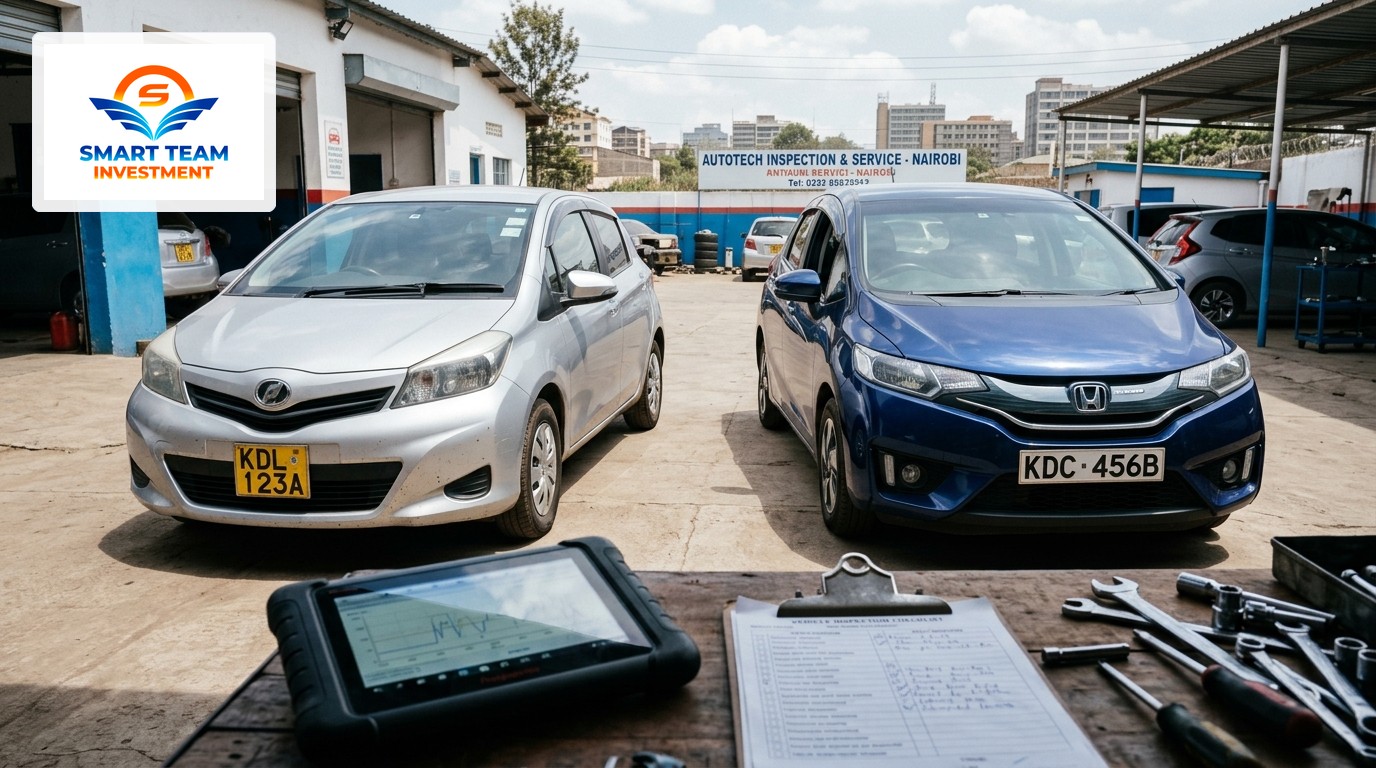
The Two-Price Gearbox: is the Vitz really more reliable than the Honda Fit?
No — they carry the same class of risk; the difference is who forgives them. The Vitz's own buying checks are "CVT gearbox issues on 2010–2015 models, suspension wear, and rust on older imports" [EVI-019]. The Fit's is gearbox malfunction from poor-quality automatic transmission fluid [EVI-030]. Same part, same failure family, two very different reputations. Because Toyota's halo is strong in Kenya, the Vitz's risk is quietly absorbed into its price while the Fit's is punished into a discount. That discount is the opportunity: buy a Fit whose gearbox and ATF history you have actually verified — cold start, low-speed test, service records — and you get the room and the stronger engine for Vitz money [EVI-029][EVI-028].
How much does each one cost in Kenya?
On identical model years, the two price ranges overlap almost completely. The Honda Fit generally ranges from around KSh 650,000 for older locally used cars to KSh 2 million or more for newer imported models [EVI-029]. The used Toyota Vitz median asking price was KSh 1,050,000 as of 8 October 2026, most listings between KSh 705,000 and KSh 1,337,500 [EVI-015].
| Model | Year | Typical asking price (KSh) | Evidence |
|---|---|---|---|
| Toyota Vitz 1.0L | 2007–2010 | 350,000–420,000 | [EVI-028] |
| Honda Fit 1.3L | 2007–2010 | 380,000–460,000 | [EVI-028] |
| Honda Fit 1.5L | 2008–2013 | 430,000–580,000 | [EVI-028] |
| Toyota Vitz 1.3L | 2013–2016 | 500,000–650,000 | [EVI-028] |
| Honda Fit | 2016 | 1.0M–1.3M+ | [EVI-029] |
| Honda Fit | 2019 | 1.35M–1.75M+ | [EVI-029] |
Older examples of both sit under KSh 500,000 [EVI-028]. That is where budget buyers find value — and where inspection discipline matters most. For the full year-by-year picture see our Toyota Vitz price in Kenya guide.
Which one is cheaper to fuel?
The Vitz 1.0L wins on fuel, and it is not close. In city driving the Vitz returns 16–18 km/l against the Fit's 15–17 km/l; on the highway 20–22 km/l against 18–20 km/l [EVI-028]. Topcar's figures for the older 2013 Fit GE are higher (20.6 km/l for the 13G) but those are best-case cycle figures, not Nairobi traffic [EVI-030].
| Condition | Toyota Vitz | Honda Fit | Evidence |
|---|---|---|---|
| City | 16–18 km/l | 15–17 km/l | [EVI-028] |
| Highway | 20–22 km/l | 18–20 km/l | [EVI-028] |
| Mixed | 18–20 km/l | 16–18 km/l | [EVI-028] |
Over a full month of driving, the gap adds up [EVI-028]. If your number one priority is the fuel bill, the Vitz 1.0L is the choice.
Which one is cheaper to service — and is it really cheaper?
The Vitz, on every line — but the real difference is distance, not price. A full service costs KSh 3,000–5,000 on the Vitz against KSh 4,000–7,000 on the Fit; brake pads are KSh 2,500–4,000 against KSh 3,500–5,500; timing belt replacement is KSh 8,000–12,000 against KSh 10,000–16,000 [EVI-028]. But the Fit's own parts, once found, are priced "comparable to prices of Toyota Vitz" [EVI-030]. The gap is not the part. It is where you can get it.
Which one is easier to get parts and mechanics for?
The Vitz — and this is the tie-breaker most Kenyan buyers actually use, though they rarely name it correctly. It is a geography tax, not a price difference. Vitz spare parts are "available everywhere" in Kenya while Fit parts are "mostly in Nairobi", and local mechanics are more familiar with Toyota engines [EVI-028]. From Nairobi to Kisumu to the small towns in the Rift Valley, almost any garage can handle a Vitz [EVI-028]. And because 62.63% of the market is informal [EVI-004], the person who buys your car in three years is more likely to be upcountry — and that buyer shops on serviceability, not boot space.
Which one has more space?
The Fit, by a wide margin. Its boot is 406 litres against the Vitz's 251 litres [EVI-028], and the Fit has noticeably more legroom thanks to a wider shell and elevated rear seats [EVI-030]. For a family of five, or anyone carrying cargo, that gap is the whole point. If space is your single need, skip straight to the Fit; if you are a single driver commuting, the Vitz is perfectly comfortable [EVI-028].
What should you check on a used Honda Fit before buying?
The gearbox first — because it is the discount and the danger in one part. Topcar's mechanic interviews point to gearbox malfunctions attributed to poor-quality automatic transmission fluid (ATF) [EVI-030], so a cold start and a proper road test are not optional. The GP5-generation hybrid uses a 7-speed dual-clutch transmission rather than a CVT, so pay particular attention to low-speed behaviour and transmission warnings [EVI-029]. The 2013 Fit's 150 mm of ground clearance is below the 165 mm Topcar recommends for Kenyan roads and it will not clear some bumps [EVI-030]. And verify the mileage, because odometer fraud affects roughly 30–45% of second-hand cars sold in Kenya [EVI-009] — a proper pre-purchase mechanical inspection is what catches it. Before you travel to view a car, read are online car markets in Kenya safe.
So should you buy the Vitz or the Fit?
Buy the Vitz if you drive mostly in town, want the lowest fuel and service bill, live outside Nairobi, or want the simplest car to maintain [EVI-028]. Buy the Honda Fit if you need the space, drive a mix of city and highway, live where Honda parts are easy to find, or want the stronger 1.5L engine — and you are willing to verify the gearbox rather than fear it [EVI-028]. Both are reliable; neither will embarrass you. The mistake is buying the cheaper sticker without pricing the parts, the fuel, the space and the exit against how you actually drive.
If your budget tops out around KSh 1.1 million [EVI-015], compare these two against the rest of the market in our best cars under KSh 1 million in Nairobi round-up; if you are weighing the whole small-hatchback set, the Axela vs Vitz vs Demio vs Fielder guide puts all four side by side.
Where can you see one?
Both models are stocked widely across the informal market [EVI-004]. Verify the seller before you travel, then compare live stock against these price bands at **current inventory**.
**See current Vitz and Fit stock →**
P.S. The market charges the Fit extra for a fear you can test away in twenty minutes. Test the gearbox, and you buy the bigger, roomier car at Vitz money — that is the Two-Price Gearbox.
Sources
- [EVI-028] — Khushi Motors, "Toyota Vitz vs Honda Fit: Which One Should You Buy in Kenya?", https://khushimotors.com/blog/toyota-vitz-vs-honda-fit, accessed 2026-10-15 (artifact: `Intelligence Division/sources/EVI-028/khushimotors-vitz-vs-fit-kenya.md`)
- [EVI-029] — Magari Deals, "Honda Fit Price in Kenya", https://www.magarideals.com/vehicle/honda/fit/143, accessed 2026-10-15 (artifact: `Intelligence Division/sources/EVI-029/magarideals-honda-fit-price.md`)
- [EVI-030] — Topcar Kenya, "2013 Honda Fit Review", https://topcar.co.ke/vehicle/2013-honda-fit-review-2/, accessed 2026-10-15 (artifact: `Intelligence Division/sources/EVI-030/topcar-2013-honda-fit-review.md`)
- [EVI-019] — Garisea/Magari Deals Toyota Vitz buyer's guide, real-world economy and common faults (card: `Verification Bureau/EVI-019.md`)
- [EVI-015] — Garisea Toyota Vitz price research (card: `Verification Bureau/EVI-015.md`)
- [EVI-004] — Mordor Intelligence, Kenya used-car market structure (card: `Verification Bureau/EVI-004.md`)
- [EVI-009] — Odometer fraud incidence, corroborated by HUMINT (card: `Verification Bureau/EVI-009.md`)
Hatchback Comparison & Running Cost Calculator
Axela vs Vitz vs Demio vs Fielder — Decision & Cost Calculator
Pick your car, your salary band and your daily commute: get the total monthly outflow, the 3-year cost, the fuel math and the mechanical risk rating
Monthly loan instalment
KSh 29,532
20% deposit · 36 months · 16% APR
Fuel @ EPRA KSh 214.03/L
KSh 7,063
660 km/mo · 20 km/L city · 33.0 L
Insurance + sinking fund
KSh 8,000
Comprehensive ~4% p.a. + service/tracker reserve
Worst-case known repair
KSh 80,000 – KSh 180,000
Low-speed CVT bearing judder & front shock/bushing knocks
Total monthly car outflow
KSh 44,595
33% of net pay in this band
3-year total outflow
KSh 1,845,416
36 instalments + deposit + KSh 30k first-week service
Mechanical risk rating
MEDIUM
Toyota Vitz (1.0L) documented failure profile
OVER YOUR CEILING — KSh 44,595/mo vs KSh 32,000 safe cap (139%)
The budget winner: lowest entry price, cheapest fuel bill, deepest parts network. Weakest point is the CVT and 1.0L 3-cylinder under load on Limuru/Ngong hills.
Net KSh 110,000 – 160,000: Max monthly car budget KSh 32,000 (loan ~20k | fuel ~7k | insurance/maintenance ~5k). A base Fielder fits only if the instalment stays near 20k.
Model prices are 2026 median asking prices, not completed sale values — 5–10% negotiation is normal once you show cash or a bank pre-approval. Fuel is modelled on 660 km/month at EPRA KSh 214.03/L; your route changes the number. Before you commit any deposit, send the chassis number or listing link to +254 752 167271 on WhatsApp for the free pre-purchase verification audit.
Frequently Asked Questions (FAQ)
They carry the same class of risk. Both depend on the transmission and its fluid — the Vitz has known CVT issues on 2010–2015 models [EVI-019] and the Fit's known fault is gearbox malfunction from poor-quality ATF [EVI-030]. The Vitz is treated as more reliable mainly because its parts and mechanics are everywhere.
The Vitz is cheaper to service. A full service costs KSh 3,000–5,000 on the Vitz against KSh 4,000–7,000 on the Fit, and brake pads are KSh 2,500–4,000 against KSh 3,500–5,500 [EVI-028]. But the Fit's own parts, once found, cost the same as the Vitz's [EVI-030] — the real gap is availability.
The Honda Fit generally ranges from about KSh 650,000 for older locally used cars to KSh 2 million or more for newer imports, with typical asking prices of KSh 1.0M–1.3M+ for a 2016 and KSh 1.35M–1.75M+ for a 2019 [EVI-029].
The Honda Fit, on space: its 406-litre boot and extra legroom are far roomier than the Vitz's 251-litre boot [EVI-028], enough to carry five adults and luggage where the Vitz feels tight.
On identical model years, yes — the two price ranges overlap almost completely [EVI-029][EVI-015], so the decision usually comes down to space, parts and who will service the car rather than the sticker price.
Always confirm the current requirements on the official NTSA portal before you pay anyone, and keep the payment receipt.