The round number tell: why smooth numbers are dirty numbers
A genuine 7-year-old Vitz in Kenya does not have a ragged, specific mileage on the clock — it has a number that reflects real commute distances, upcountry trips, the year the owner's mother was sick and they drove to Kisumu every weekend. Fraud mileage is smooth. It lands on round thousands, often round ten-thousands, because the person winding it back picks a number that "makes sense" for the model year and the asking price.
PrepurchaseKenya estimates 1 in 10 online listings have tampered mileage [EVI-059]. EVI-009 puts the broader market figure at 30–45%. The difference: informal channels (62.63% of the market [EVI-004]) are where the clocking happens. Online listings are slightly more visible — but the 96% chassis/VIN omission rate [EVI-010] means even online, you cannot verify the car's identity, let alone its history.
The paper trail: the only mileage that counts
For a Japanese import (which is 94% of Kenya's used vehicles [EVI-002]), the mileage chain is:
``` Japanese Auction Sheet → Export Certificate → NTSA Import Entry → Kenya Service Logs → Current Odometer ```
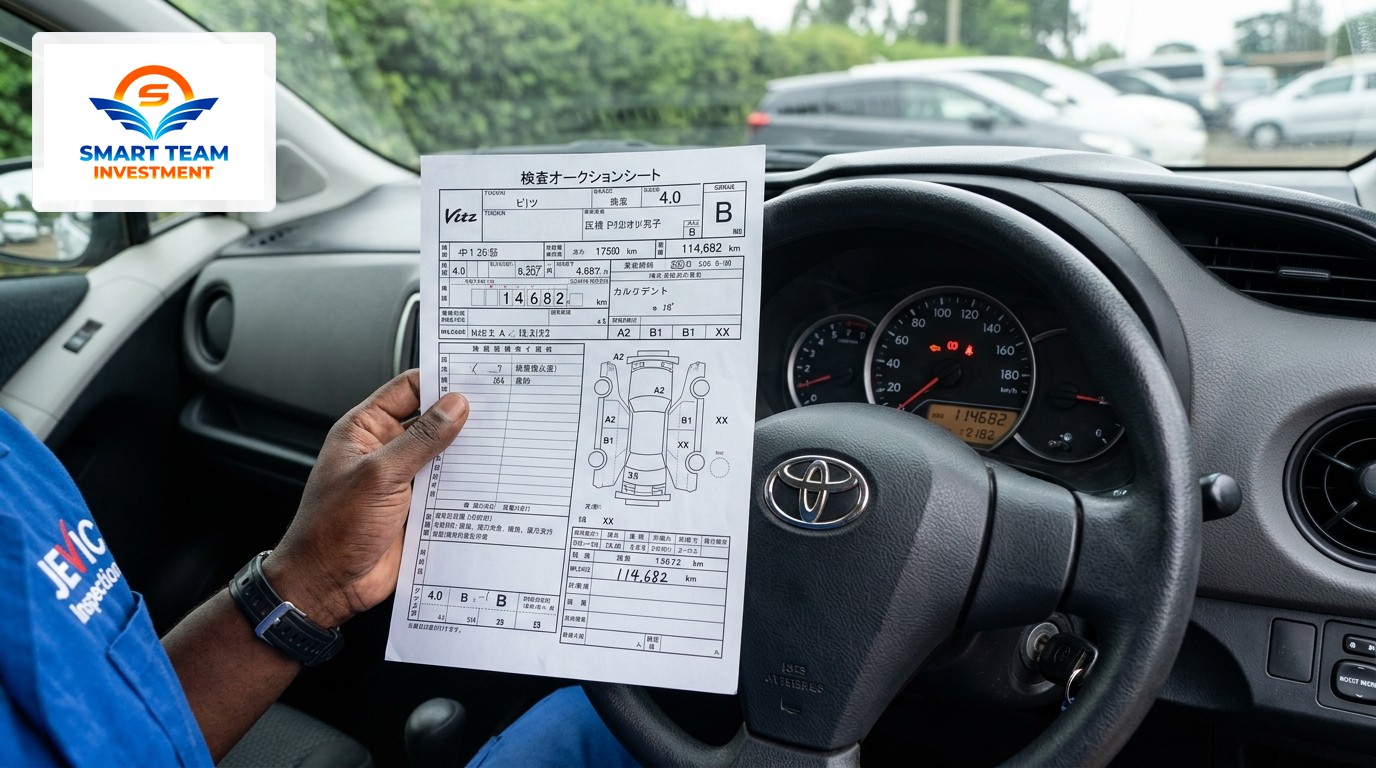
Every link must be present and match. The auction sheet (issued by USS, JAA, TAA, etc.) records the mileage at auction in Japan. The export certificate (deregistration) confirms it. NTSA records the import. Kenya service logs (oil changes, inspections) bridge the gap to today. If any link is missing — "the auction sheet is lost," "the seller doesn't have service records" — the odometer is unverified.
AutoInspectKE confirms: imported units sometimes arrive with readings that don't match their auction records [EVI-060]. Digital odometers can be altered in minutes with cheap tools. The incentive is massive: mileage is the primary price lever within each year band (2008–2014 KSh 500k–900k; 2015–2018 KSh 750k–1.3M [EVI-057]).
Physical sync: the car cannot lie about wear
Sellers can change the dashboard digits. They rarely change the wear on contact points. PrepurchaseKenya and AutoInspectKE both prescribe the same physical sync checks [EVI-059][EVI-060]:
| Contact Point | 40,000 km Look [EVI-059] | 150,000+ km Look [EVI-059] |
|---|---|---|
| Brake / Accelerator Pedals | Near-new rubber, sharp grooves | Worn smooth, metal showing through |
| Steering Wheel | Texture intact, no shine | Shiny, smoothed leather/plastic on grip areas |
| Gear Knob / Selector | Crisp edges, no wear | Rounded, shiny, loose fit |
| Driver's Seat Bolster | Firm, minimal side wear | Sagging, wrinkled, compressed foam |
| Door Striker Plate (driver's) | Light scratches | Deep grooves, metal wear from thousands of entries |
If the odometer says 45,000 km [UNSOURCED: our read] and the pedals are worn to metal, the car has done 150,000+ km [EVI-059]. The steering wheel shine typically appears around 100,000 km [EVI-059] of city driving. These are inspector heuristics, not lab thresholds — but they are the only DIY checks that work.
Digital forensics: the ECU does not forget
Modern cars store mileage in multiple control units — not just the dashboard cluster. The Transmission Control Module (TCM), ABS module, and ECU all log distance. An OBD2 scanner (professional grade, not a KSh 2,000 [UNSOURCED: our estimate] ELM327 dongle) can often read the true mileage from these modules [EVI-059][EVI-060]. This is much harder to fake than the dashboard display.
AutoInspectKE adds: watch for warning lights or an odometer showing dashes — these can indicate the cluster was manipulated [EVI-060]. On analogue clusters (pre-2010), misaligned numbers or fingerprints inside the lens hint at tampering.
The safest check: an independent pre-purchase inspection (PrepurchaseKenya, AutoInspectKE, Motorlab) that verifies ECU mileage against the paper trail and physical wear.
The cloning nexus: fake mileage often hides a fake car
Motorlab Kenya, a forensic investigator, states: mileage tampering and vehicle cloning are two sides of the same coin [EVI-062]. Cloners disguise stolen or written-off vehicles with a false identity — new chassis number, fresh paint, doctored odometer. "A car with 180,000 km suddenly becomes a 'barely used import.'" The records are manipulated to fit: forged service logs, falsified import documents, adjusted NTSA entries.
Legitimate odometer changes (cluster failure in older models) are rare. When they happen, legitimate garages must document the change and record the previous mileage in service logs or NTSA records. If that documentation is missing, assume tampering [EVI-062].
This means a suspicious mileage on a Vitz is not just a pricing issue — it is a identity issue. The car sharing its VIN with another, or previously written off in Japan, or stolen — the fake mileage is the cover story.
Practical decision rule for Vitz buyers
| Odometer Reading | Paper Trail | Physical Sync | ECU Verified | Decision |
|---|---|---|---|---|
| Any | Complete (auction→NTSA→service) | Matches | Matches | Buy — mileage is what it says |
| Round number (40k, 50k, 60k, 80k, 100k) | Missing links | Mismatch | Not done | Walk away — classic fraud profile |
| High (120k+) | Complete | Matches | Matches | Buy — honest high mileage > fake low mileage |
| Low (<60k on 2015+) | Complete | Matches | Matches | Verify extra carefully — genuinely rare, but possible |
The Vitz-specific context
The Vitz's price bands make mileage fraud especially profitable [EVI-057]:
- A 2014 Vitz at 60,000 km [EVI-057] might list at KSh 850,000 [EVI-057]
- The same car at 120,000 km [EVI-057] lists at KSh 650,000 [EVI-057]
- The KSh 200,000 [EVI-057] gap is pure incentive to roll back
And the CVT risk window (2010–2015/2017 [EVI-057][EVI-061]) means hidden high mileage hides hidden CVT wear. A rolled-back 2012 Vitz showing 50,000 km [UNSOURCED: our read] may have a CVT that has actually done 180,000 km [UNSOURCED: our read] with zero fluid changes. That is the KSh 200,000+ [UNSOURCED: our estimate] repair bill waiting for you.
So what mileage should you avoid?
Avoid the smooth number without the paper trail. Not a suspiciously round six-figure reading. Not a high-mileage car disguised as low. Avoid a plausible round number on a 2014 Vitz with no auction sheet, no service logs, shiny pedals, and a seller who "lost the records." The number on the dash is the seller's story. The paper trail, the wear, and the ECU are the truth.
Where to see one
Verified Vitz units with checked mileage are at **current inventory**. Compare live stock against the price bands and demand the paper trail.
P.S. The market prices low mileage like a virtue. In Kenya, it is usually a vice — the cost of the lie. The round number is the tell. The paper trail is the proof. No trail, no deal.
Sources
- [EVI-009] — Odometer fraud incidence (30–45% of Kenyan second-hand cars)
- [EVI-010] — Open classifieds omit chassis/VIN in 96% of listings
- [EVI-057] — Magari Deals, "Toyota Vitz in Kenya: 2026 Buyer's Guide" (price bands by year)
- [EVI-059] — PrepurchaseKenya, "The Ultimate Guide to Detecting Mileage Fraud in Kenya"
- [EVI-060] — AutoInspectKE, "Is the Mileage Genuine? Spotting Odometer Fraud in Kenya"
- [EVI-062] — Motorlab Kenya (forensic), LinkedIn post on mileage tampering & cloning nexus
- [EVI-002] — Japan supplies ≈94% of Kenya's used-vehicle imports
- [EVI-004] — Informal dealers ≈62.63% of Kenya's used-car market
Odometer Rollback & Mileage Verification Checker
Free Interactive Tool: Japanese Auction Sheet Self-Audit
Work through this with the actual sheet in front of you. It scores what you find — it does not look anything up.
Overall grade on the sheet
Mileage stars beside the odometer
★ is the mileage-doubt rating, not a panel mark. No star means accepted as accurate.
Chassis on the sheet matches the car
Compare the plate, the door jamb and the auction sheet. All three must agree.
W1 / W2 / W3 repair marks present
W = that panel was repaired. W1 minor, W2 visible, W3 major.
XX (panel replaced) anywhere on the diagram
…and any XX on a pillar, core support or floor
This is the distinction that matters. A front wing is bodywork; a B-pillar is not.
冠水 or 水没 in the inspector notes
Flood appears only in the handwritten notes, never in the damage grid.
骨格修正 (frame correction) in the notes
I have read the notes in translation
Frequently Asked Questions (FAQ)
Round numbers that 'look right' for the car's age — these are the classic rollback targets because they maximise price while appearing plausible [EVI-059][EVI-060].
Cross-check the auction sheet (Japan), export certificate, NTSA records, and service logs. The chain must be unbroken. Then do a physical sync check: pedals, steering wheel, gear knob, seat, door striker. Finally, an OBD2 scan reads true mileage from the ECU/TCM [EVI-059][EVI-060].
No. In Kenya, low mileage without a paper trail = high fraud probability. A car with honest high mileage and full history is safer than one showing suspiciously low mileage with none [EVI-059][EVI-060].
Local term for odometer rollback. Digital odometers can be altered in minutes with cheap tools. Imported units sometimes arrive with readings that don't match their auction records [EVI-060].
Yes. Forensic investigators link mileage tampering and vehicle cloning — cloners disguise stolen/written-off cars with false identity, new chassis number, fresh paint, and a doctored odometer [EVI-062].
Always confirm the current requirements on the official NTSA portal before you pay anyone, and keep the payment receipt.