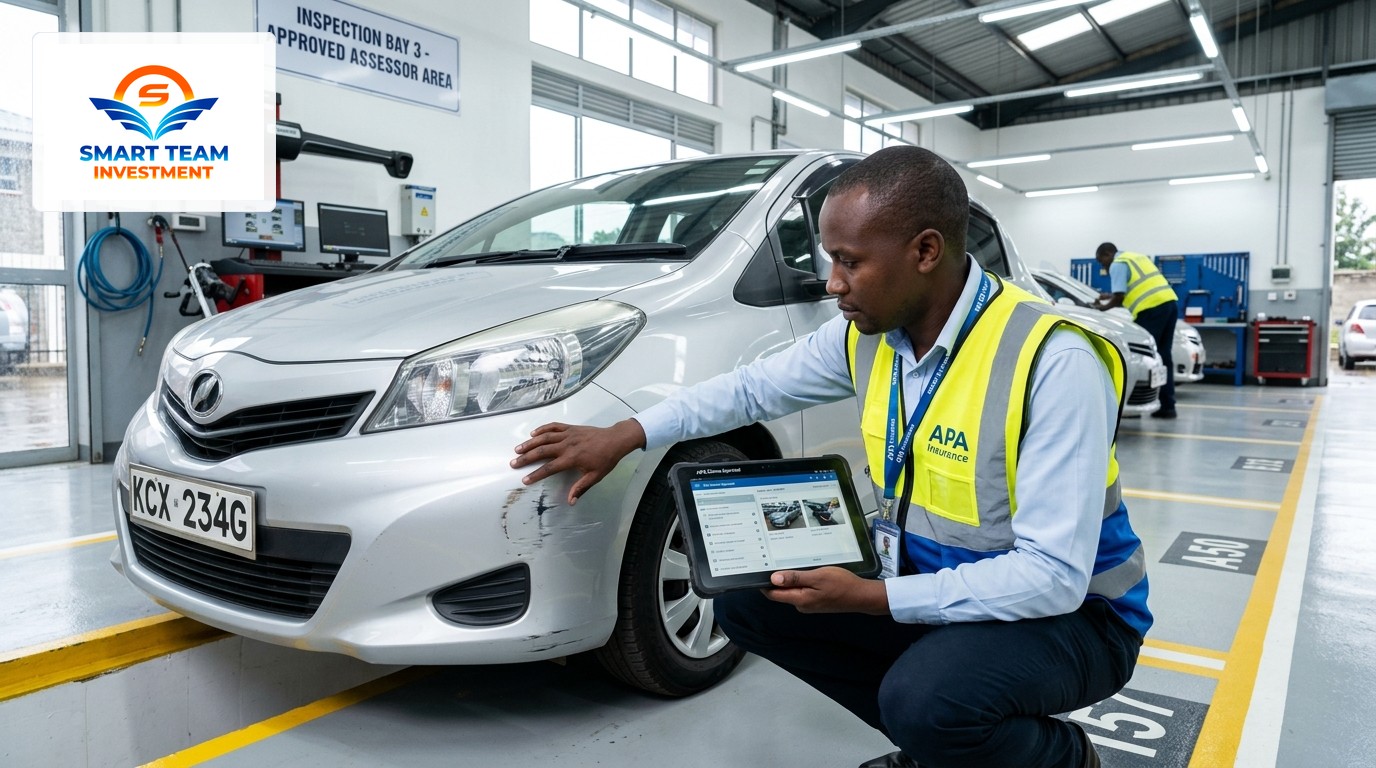
The IDV Write-Off Trap: why comprehensive can cost you the car
The trap is simple: insurers price on the car's value (IDV). On a cheap Vitz, one moderate knock can exceed the repair-to-value threshold and the insurer writes the car off.
Here is the math. Comprehensive premiums are rated as a percentage of the Insured Declared Value — typically 3%–7.5%, subject to a minimum premium of about KES 37,500 [EVI-039][EVI-040]. A Vitz valued at KES 1,000,000 at 5% produces a base premium of KES 50,000 and an illustrative total of KES 50,265 [EVI-040]. But a Vitz valued at KES 500,000 at 4% calculates to KES 20,000 — below the minimum — so the KES 37,500 floor applies, making the effective rate 7.5% [EVI-040].
Now the claim. Kenyan insurers typically treat a vehicle as a constructive total loss (CTL) when repair costs exceed 75% of the IDV [EVI-040 counter-evidence]. On a KES 700,000 Vitz, that threshold is KES 525,000. A front-end hit — bumper, radiator, headlight, bonnet, labour — easily reaches KES 150,000–250,000 at current parts and labour rates. On a KES 500,000 Vitz, the threshold drops to KES 375,000. The same hit is now a write-off.
The insurer pays you the IDV (minus your excess) and keeps the salvage. You lose the car. The comprehensive premiums you paid bought you a policy that evaporates the asset at the first meaningful claim.
What the premium actually buys you
| Cover | Annual cost (illustrative) | What it pays | What it does not pay |
|---|---|---|---|
| Third-Party Only | KES 7,574 [EVI-040] | Injury/death/property damage you cause to others | Your own car: accident, theft, fire |
| Comprehensive (KES 1M Vitz @ 5%) | ~KES 50,265 [EVI-040] | Own damage + theft + fire + third party | Excess; wear; mechanical failure; write-off threshold |
| Comprehensive (KES 500K Vitz @ min) | ~KES 37,800+ [EVI-040] | Same as above | Same as above — but write-off triggers at ~KES 375K repair |
The minimum premium distortion means lower-value Vitz units pay a higher *effective* rate for the same cover — and face a lower write-off threshold.
The excess and exclusions that void claims
Even before the write-off threshold, two contract terms bite Vitz owners:
Standard excess: Typically 2.5%–5% of IDV (minimum KES 10,000–20,000) [EVI-040]. On a KES 700,000 Vitz at 2.5%, that is KES 17,500 out of pocket before the insurer pays a shilling.
Excess protector add-on: Costs ~0.25%–1% of IDV (min KES 5,000–10,000) [EVI-040]. It waives the standard excess on own-damage claims — but not the write-off threshold.
Authorized repair limit: Many policies cap cash-in-lieu repairs at KES 50,000 [EVI-040]. Above that, you must use the insurer's assessor and approved garage — where the write-off calculation happens.
Vehicle age restrictions: Cars over 10–12 years may only qualify for TPO or TPFT (Third-Party Fire & Theft), not comprehensive [EVI-040]. The 8-year import rule [EVI-006] means most Vitz units in Kenya are 8–15 years old — check eligibility before assuming comprehensive is available.
The decision rule: TPO + repair fund vs. comprehensive
Buy comprehensive if: you cannot absorb a total loss (no savings, car is financed, you need the vehicle daily and cannot replace it in 30 days). The bank will require it anyway [EVI-039].
Buy TPO + repair fund if: you have KES 100,000–200,000 liquid that you can allocate to car repairs. At KES 7,574/year for TPO [EVI-040], the ~KES 30,000–42,000 annual saving vs. comprehensive builds a repair fund fast. Most Vitz repairs (suspension, brakes, minor panel work) fall under KES 50,000 — below the authorized repair limit and the write-off threshold.
The middle ground: Third-Party Fire & Theft (TPFT) — covers theft and fire but not own-damage accident. Priced between TPO and comprehensive. Ask your broker for a quote; not all underwriters offer it on older Vitz units.
What to check before you pay
1. Get the IDV in writing — not the purchase price, not the "market value" the seller claims. The insurer's valuation sets the write-off threshold. 2. Ask for the CTL percentage — 75% is common; some use 70% or 60% for cars over 10 years [EVI-040]. Get it in the policy schedule. 3. Check excess protector cost — if it adds KES 5,000–10,000 [EVI-040], it may be worth it for peace of mind, but it does not move the write-off line. 4. Verify the car has no prior write-off — vehicle history is fragmented; pre-import Japanese logs cost US$8–50 and NTSA owner search is KES 500 [EVI-011]. Domestic write-off databases are closed to the public [EVI-011]. 5. Confirm comprehensive is available for the Vitz's age/year. Some underwriters decline comprehensive on cars >10 years.
Where to see one
Both cover types are widely available across the informal market [EVI-004]. Compare live quotes against these bands at **current inventory**.
P.S. The comprehensive premium on a cheap Vitz buys you a policy that can total the car at the first real claim. Do the math: if a KES 150,000 repair writes off your KES 600,000 car [EVI-040], you didn't buy insurance — you bought a lottery ticket where the prize is losing the car. TPO plus a repair fund is the discipline that keeps the Vitz in your driveway.
Sources
- [EVI-039] — Vike Insurance, "Comprehensive Motor Insurance Kenya", https://www.vikeinsurance.co.ke/products/motor/comprehensive, accessed 2026-10-15 (artifact: `Intelligence Division/sources/EVI-039/vikeinsurance-comprehensive-rates.md`)
- [EVI-040] — Vike Insurance, "Third-Party Only (TPO) Motor Insurance Kenya" & Amssurity, "How Much Is Car Insurance in Kenya? 2026 Rates", https://www.vikeinsurance.co.ke/products/motor/third-party-only & https://www.amssurity.co.ke/blog/how-much-is-car-insurance-in-kenya, accessed 2026-10-15 (artifacts: `Intelligence Division/sources/EVI-040/vikeinsurance-tpo-rates.md`, `Intelligence Division/sources/EVI-040/amssurity-worked-examples.md`)
- [EVI-015] — Garisea Toyota Vitz price research (card: `Verification Bureau/EVI-015.md`)
- [EVI-011] — Vehicle history fragmentation, corroborated by HUMINT (card: `Verification Bureau/EVI-011.md`)
- [EVI-004] — Mordor Intelligence, Kenya used-car market structure (card: `Verification Bureau/EVI-004.md`)
- [EVI-006] — Kenya 8-year import age limit (card: `Verification Bureau/EVI-006.md`)
Vitz Comprehensive vs TPO Insurance Calculator
Kenyan Car Insurance & Excess Calculator
Underwriting premium stack + mandatory out-of-pocket excess risk (2026)
Basic Premium (4%)
KSh 42,500
Statutory Levies
KSh 191 + KSh 40
AA Road Rescue
KSh 6,500
Courtesy Car
KSh 8,100
TOTAL ANNUAL PREMIUM
KSh 57,331
GREEN — POLICY STRUCTURED CORRECTLY
Private use with comprehensive cover and no young-driver penalty. Expect KSh 27,500 out-of-pocket (third-party excess + own-damage excess) before the insurer settles your claim.
Own-Damage Excess (2.5%)
KSh 20,000
Third-Party Property Excess
KSh 7,500
Young / Novice Penalty
KSh 0
Verify your cover note via IRA DMVIC USSD *352# before paying a premium. Keep at least KSh 20,000 liquid to cover mandatory excesses, and lock your sum insured with an IRA-approved valuer.
Frequently Asked Questions (FAQ)
Typically 3%–7.5% of the car's insured value, subject to a minimum premium of about KES 37,500 [EVI-039][EVI-040]. A Vitz valued at KES 1,000,000 at 5% yields ~KES 50,265 all-in; a KES 500,000 Vitz hits the KES 37,500 floor, making the effective rate 7.5%.
Private TPO starts at KES 7,500 base premium, approximately KES 7,574 total after training levy (0.2%), Policyholders Compensation Fund (0.25%), and KES 40 stamp duty [EVI-040].
If you can absorb the loss of the car — i.e., you have a repair fund or could replace the vehicle without finance — TPO plus a repair fund is often rational. Comprehensive makes sense if a total loss would leave you stranded or if a financier requires it.
Kenyan insurers typically treat a vehicle as a constructive total loss when repair costs exceed 75% of the Insured Declared Value (IDV) [EVI-040 counter-evidence]. Some may use lower thresholds (60–70%) for older cars.
Yes — comprehensive covers theft, fire, and own-damage accident. TPO does not cover theft at all [EVI-039]. If theft is a primary concern, comprehensive or Third-Party Fire & Theft (TPFT) is required.
Always confirm the current requirements on the official NTSA portal before you pay anyone, and keep the payment receipt.