The 11:15 PM Hybrid Scroll — and the Two Voices in Your Head
"Hybrids save you millions on fuel!" promises every car dealer along Ngong Road and Mombasa Road.
"Don't buy a hybrid — the battery will burn your life savings!" warns every mechanic in Industrial Area.
*Who is actually telling the truth?*
It is 11:15 PM on a Sunday night. You are scrolling through Jiji, Facebook Marketplace, and WhatsApp dealer groups, staring at a gleaming 2016 Toyota Aqua listed at KSh 1,350,000.
Your salary is KSh 120,000 gross. Petrol is sitting at an all-time high of KSh 214.03 per litre. You currently spend KSh 14,000 every month just feeding a thirsty petrol car in 2-hour Thika Road or Mombasa Road traffic jams.
The dealer swears the Aqua will achieve 35 km/L and cut your fuel bill in half. But your uncle warned you at a family gathering that if the hybrid battery dies, you will be forced to spend KSh 300,000 cash or turn the vehicle into a stationary metal box outside your estate.
Before you wire a single shilling as a deposit or sign a bank asset finance agreement, you need the real arithmetic — not dealer hype, not garage horror stories. Here is the forensic breakdown: is a hybrid actually cheaper in Kenya, or is the battery going to eat all your savings?
The Big Import Tax Myth: "Hybrids Attract Lower Duty in Kenya"
The most repeated justification for buying a hybrid is a tax claim: *"Hybrids attract lower excise duty at the Mombasa Port."*
Before evaluating fuel numbers, you must understand where that claim comes from — and why it is false at the import gate.
Kenya's motor vehicle excise duty is charged strictly by engine capacity (cc), not by a "hybrid" or "synergy drive" badge on the tailgate:
| Engine Capacity (cc Band) | Statutory Excise Duty Rate | Applicable Vehicle Examples |
|---|---|---|
| Under 1500cc | 20% Excise Duty | Toyota Aqua (1,490cc), Vitz (1,000–1,300cc), Passo, Axio Hybrid |
| 1500cc – 3000cc | 25% Excise Duty | Fielder Hybrid (1,496cc), Prius (1,797cc), Premio, CX-5 |
| Over 3000cc | 35% Excise Duty | Land Cruiser Prado, Lexus RX450h (3,500cc) |
| Pure Battery-Electric (EV) | 10% Reduced Excise Duty | Nissan Leaf, BYD Atto 3, Tesla Model 3 |
> 💡 THE IMPORT GATE REALITY CHECK: A Toyota Aqua runs a 1,490cc petrol engine paired with an electric motor. It sits in the under-1500cc band and pays the exact same 20% excise duty as a 1,000cc or 1,300cc petrol Vitz. The 10% reduced excise rate is legally reserved exclusively for 100% pure EVs. Dealer claims of hybrid tax relief rely on outdated proposals never passed into law. Do not buy a hybrid expecting a government duty discount. Buy it for fuel savings — and only if your driving pattern can actually earn that money back.
Part 1: The Toyota Aqua's 3 Fuel Numbers (and Which One to Use)
Every Kenyan forum quotes a different figure because three distinct numbers exist in the wild:
1. The Japanese Brochure Figure (35.4 km/L): Achieved on sterile JC08 test tracks with zero air conditioning and zero cargo. You will never hit this on Kenyan roads. 2. Real-World Nairobi City Traffic (30–33 km/L): The realistic number logged by disciplined Aqua drivers crawling through Westlands, Upper Hill, Kilimani, and Mombasa Road jams. 3. The Budget-Safe Baseline (25–28 km/L): The pessimistic figure to plan with if you carry passengers, run AC constantly, or make weekend highway trips.
By comparison, a petrol Toyota Vitz (1.3L) or Axio (1.5L) delivers 15–18 km/L in identical Nairobi traffic.
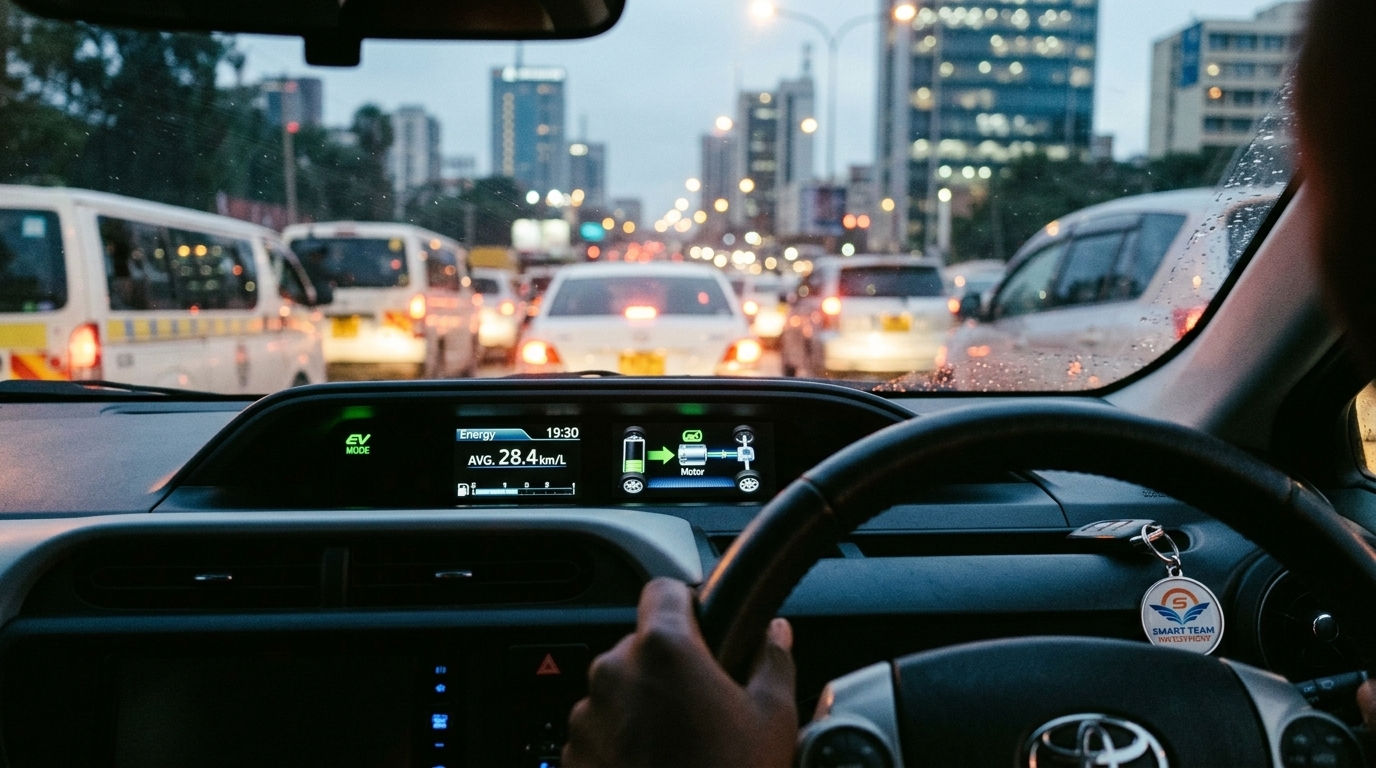
The hybrid's electric motor takes over during low-speed stop-and-go crawling (under 40 km/h) — it consumes zero petrol sitting in gridlock where a petrol engine idle-burns your shillings.
The Real Monthly Fuel Math (EPRA KSh 214.03/L Benchmark)
Assuming a typical Nairobi commute of 1,000 km per month in heavy city traffic:
| Vehicle & Engine Size | Real-World Economy | Monthly Fuel | Monthly Cost @ KSh 214.03/L | Annual Fuel |
|---|---|---|---|---|
| Petrol Toyota Vitz (1.3L) | 16.0 km/L | 62.5 L | KSh 13,377 | KSh 160,524 |
| Toyota Aqua Hybrid (City Baseline) | 27.0 km/L | 37.0 L | KSh 7,919 | KSh 95,028 |
| NET SAVINGS | +11 km/L | 25.5 L saved | ≈ KSh 5,458 / month | ≈ KSh 65,496 / year |
Push that to 1,500 km/month (or daily Uber/Bolt runs or sales calls across Nairobi, Mombasa or Nakuru) and the savings leap to KSh 8,187/month — KSh 98,244 a year.
Interactive Tool: Hybrid Fuel Savings & Battery Payback Calculator
Before you commit to a deposit on that gleaming Aqua, run your own payback math. The calculator below models the monthly and annual fuel savings, the exact months it takes to recover the hybrid premium, and the monthly battery sinking fund you should be building.
Hybrid Fuel Savings & Battery Payback Calculator
EPRA KSh 214.03/L benchmark · Aqua-class hybrid (27 km/L) vs petrol Vitz (16 km/L) · battery replacement sinking fund
Monthly petrol — equivalent (16 km/L)
Heavy city traffic (Nairobi / Mombasa / Nakuru)
KSh 10,300
Monthly petrol — hybrid (27 km/L)
KSh 6,104
Months to pay back premium
36 months (~3.0 yrs)
Monthly battery sinking fund (36-month)
KSh 5,000
Net Fuel Savings
KSh 4,196/mo · KSh 50,357/yr
3-year net (after premium): KSh 1,070 saved · 5-year: KSh 101,783 saved
CITY MODE — HYBRID PAYS BACK IN 36 MONTHS
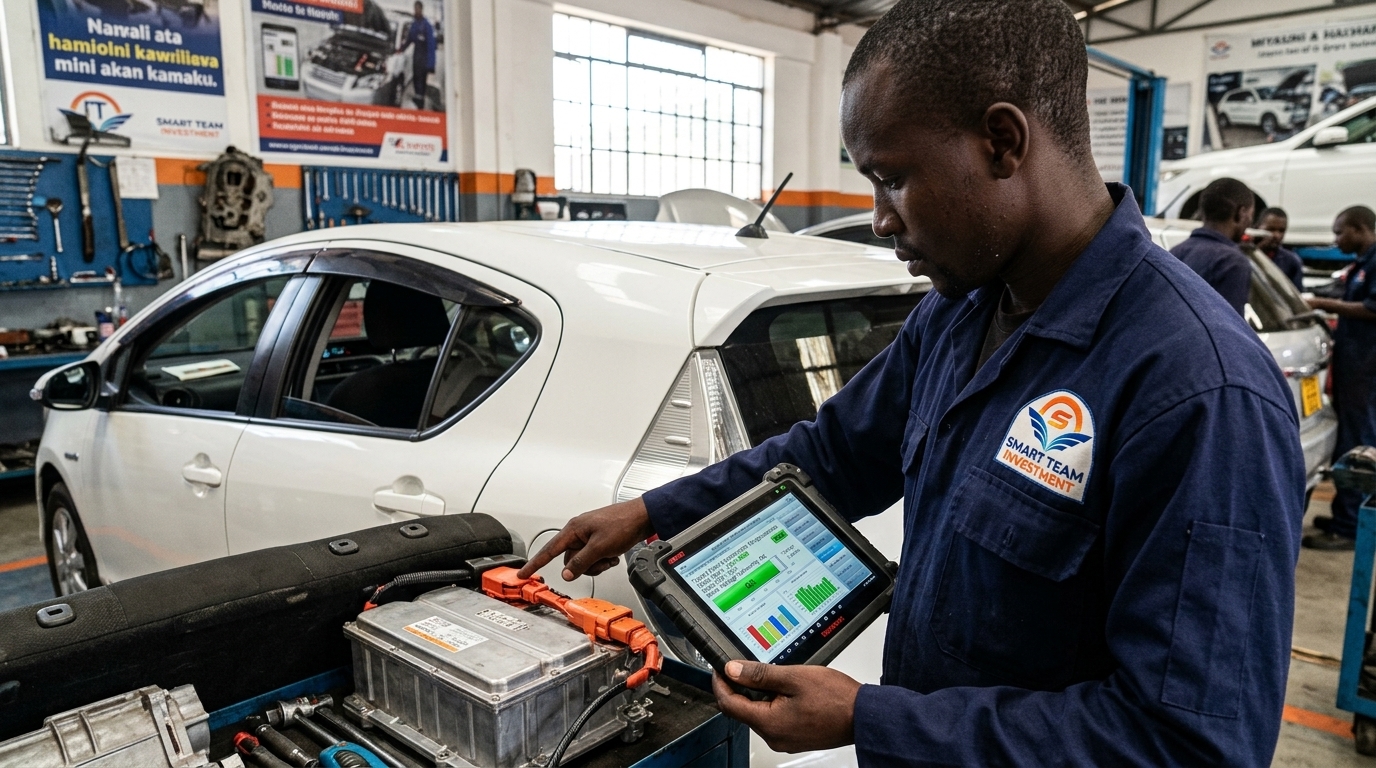
At current EPRA prices your savings recover the upfront premium in ~36 months. Still never buy without an OBD-II battery State-of-Health (SOH) scan showing 70%+ — a dead pack is a KSh 180,000 surprise under the back seat.
Budget figures assume an Aqua-class hybrid at 27 km/L city vs a 1.3L petrol Vitz at 16 km/L; your real numbers vary with traffic, driving style and battery SOH. Excise duty is charged by engine capacity (cc), not the hybrid badge — a 1,490cc Aqua pays the same 20% as a petrol Vitz. The estimate is educational, not a quotation; always get our free pre-purchase hybrid verification audit before depositing.
The result is an educational estimate based on EPRA prices and real-world Kenyan traffic figures — not a formal quotation — but it is the same logic our team applies when quoting hybrid verification audits.
Part 3: The Hybrid Battery — The KSh 300,000 Clock Under the Back Seat
This is the exact point where cheap hybrid dreams turn into expensive workshop nightmares.
A hybrid traction battery degrades over time from age, heat, and charge cycles — regardless of odometer readings. Kenyan market costs today:
| Battery Item | Real Market Cost in Kenya | Notes |
|---|---|---|
| Independent Battery SOH OBD-II Test | KSh 3,000 – 7,000 | Mandatory scan before any deposit |
| Individual Cell Module Replacement | KSh 15,000 – 35,000 | Short-term fix for bad voltage cells |
| Reconditioned / Rebuilt Pack (Aqua / Prius) | KSh 150,000 – 200,000 | 6–12 month local garage warranty |
| Brand-New OEM Toyota Pack (Fitted) | KSh 250,000 – 300,000 | 8–10 years of fresh life |
| Premium SUV Pack (Harrier / RX450h) | KSh 220,000 – 350,000 | High-voltage multi-module pack |
| Average Hybrid Battery Lifespan | 10 – 15 years | Degradation accelerates after Year 8 |
Rule 1: Never buy a hybrid without an independent Battery SOH report. A healthy pack must show OBD-II State-of-Health of 70%+ with cell-module voltage variance under 0.2V. Buy a 2014 Aqua whose SOH has dropped to 45% and the ECU forces the petrol engine to run continuously — fuel economy collapses from 27 km/L to 15–16 km/L (petrol levels), wiping out the entire fuel-savings thesis while leaving you exposed to a KSh 200,000 replacement bill. Dealers who refuse an OBD-II battery test are hiding a degraded pack.
Rule 2: Build a dedicated monthly battery sinking fund. Buy a 2019 fresh import — the oldest year KEBS will now clear — and the pack is already 7 years old before you drive away, reaching 10–12 years inside your 3-year ownership window. Set aside KSh 4,000/month into an M-Pesa Lock or high-yield account — 36 months accumulates KSh 144,000, ready if a *"Check Hybrid System"* light appears.
*(Note: Toyota NiMH hybrids — Aqua, Axio, Fielder, Prius — use proven modular packs. Do not confuse them with series hybrids like the Nissan Note e-POWER, which run a different inverter and battery architecture, as detailed in Part 10: 3 Fresh Imports Kenyans Buy in Thousands That I Would Think Twice About.)*
Final Verdict: Is a Hybrid Cheaper for You?
| Buyer Scenario | The Recommendation | Financial Justification |
|---|---|---|
| BUY THE HYBRID IF... | You drive 10,000+ km/year, 80% of it in heavy city traffic (Nairobi, Mombasa, Nakuru), your OBD-II scan proves 70%+ SOH, and you'll keep the car 3+ years. | ~KSh 65,500/yr savings wipes out the premium within 26 months, then turns profitable. |
| SKIP THE HYBRID IF... | You mostly drive highways, your annual mileage is under 6,000 km, or the seller refuses an independent battery test. | Highway driving yields zero advantage — you never recover the premium. |
> The "WhatsApp Group" One-Liner: *"A Toyota Aqua genuinely cuts your monthly fuel bill in half in Nairobi city traffic and pays back its premium in 2.2 years — but don't buy it expecting a government tax discount, and NEVER pay a deposit without an OBD-II Battery State-of-Health report, because a dead battery pack is a KSh 200,000 surprise waiting under the back seat."*
Frequently Asked Questions (Hybrid Cars in Kenya)
No. Motor vehicle excise duty in Kenya is charged by engine capacity (cc) — not by a hybrid badge. A 1,490cc Toyota Aqua pays the exact same 20% excise duty as a 1,000cc–1,300cc petrol Toyota Vitz. The reduced 10% excise rate applies exclusively to 100% pure battery-electric vehicles (EVs).
A reconditioned or rebuilt Toyota Aqua battery pack costs between KSh 150,000 and KSh 200,000 in Kenya, while a brand-new original-equipment (OEM) Toyota battery pack costs KSh 250,000 to KSh 300,000 including fitting.
Toyota hybrid battery packs generally last 10 to 15 years (200,000 to 250,000 km). Capacity degradation typically accelerates after Year 8, which is why an OBD-II Battery State-of-Health (SOH) test showing 70%+ is essential before buying an older import.
No — savings are minimal on open highways. Above 80–100 km/h the petrol engine runs continuously while carrying the additional weight of the battery pack, returning 18–22 km/L, which is nearly identical to a standard small petrol engine.
Always confirm the current requirements on the official NTSA portal before you pay anyone, and keep the payment receipt.
Before You Wire a Deposit: Claim Your Free Hybrid Battery & Cost Audit
Planning to buy a Toyota Aqua, Fielder Hybrid, or Honda Fit Hybrid this month? Don't gamble your hard-earned savings on dealer promises.
We offer a 100% Free Pre-Purchase Hybrid Verification Audit for Kenyan buyers: 1. Live Battery SOH Scan Verification: We analyze the OBD-II cell voltage delta and capacity percentage before you pay a deposit. 2. CRSP Duty & Valuation Match: We verify the valuer's Open Market Value (OMV) against your bank asset finance loan limit. 3. Auction Sheet & Mileage Verification: We translate the original Japanese auction sheet to ensure the chassis isn't an R-Grade collision unit with clocked mileage.
📱 WhatsApp "HYBRID AUDIT" to +254 790 406903 to speak directly with our neutral buyer-side team before making your offer!
*Also review our related buyer protection guides: How to Avoid Logbook Scams in Kenya and 3 Fresh Imports Kenyans Buy in Thousands That I Would Think Twice About.*
P.S. (TL;DR)
A Toyota Aqua saves KSh 5,458/month over a petrol Vitz at KSh 214.03/L; the KSh 150,000 premium pays back in ~26 months of city crawling; the Fielder Hybrid premium pays back in ~35 months.
- Excise duty is 20% regardless of the hybrid badge — there is no import tax discount.
- Highway driving never recovers the premium; city crawling does.
- A dead battery costs KSh 150,000–300,000 — always test OBD-II Battery SOH (70%+) before buying.
- Build a KSh 4,000/month battery sinking fund if buying an older import.
WhatsApp "HYBRID AUDIT" to +254 790 406903 for a Free Pre-Purchase Hybrid Verification Audit before a single shilling moves.
The Hybrid vs. Petrol True Cost & Payback Sheet
Whether a hybrid actually costs less in Kenya — the fuel saving, the battery risk, and the payback maths.
What you will discover inside
- ✓Real fuel consumption and fuel-price assumptions for a hybrid vs. petrol
- ✓The hybrid battery warranty and what voids it
- ✓The maintenance differences that offset (or add to) the fuel saving
- ✓A worked payback calculation across a realistic ownership period
- ✓The resale profile of a hybrid vs. an equivalent petrol
Free Download: The Hybrid vs. Petrol True Cost & Payback Sheet
100% free. Delivered instantly to your email and WhatsApp.